Key facts
- Date and time: Tuesday, 29 March 2022. According to the investigation, launch at about 08:14, impact at 08:35 Kyiv time. On the day, the State Emergency Service reported “about 08:45”
- Place: 22 Admiralska Street, Mykolaiv. A nine-storey administrative building owned by the regional council, housing the Regional Military Administration, the regional Commercial Court and other organisations
- Dead: 37 names on the regional administration’s list of 5 April 2022; 36 people in the investigation’s materials (21 civilians and 15 servicemen). The difference has not been explained
- Wounded: 38 according to the investigation: 27 civilians, 6 servicemen, 5 police officers
- Weapon: two versions. Ukrainian investigators: a 9M727 cruise missile fired by an Iskander system, launched from Crimea. Truth Hounds and IPHR (2022): a 3M14T Kalibr, most likely from the frigate Admiral Essen
- Suspects: Army General Aleksandr Dvornikov, Lieutenant General Mikhail Zusko, Colonel Nikolai Goraichuk. All notices of suspicion were issued in absentia
- Legal status: Truth Hounds and IPHR call the strike a war crime; investigators classify it under Art. 28(2) and Art. 438(2) of the Criminal Code of Ukraine. There is no verdict, and we found no reports that the case has gone to court
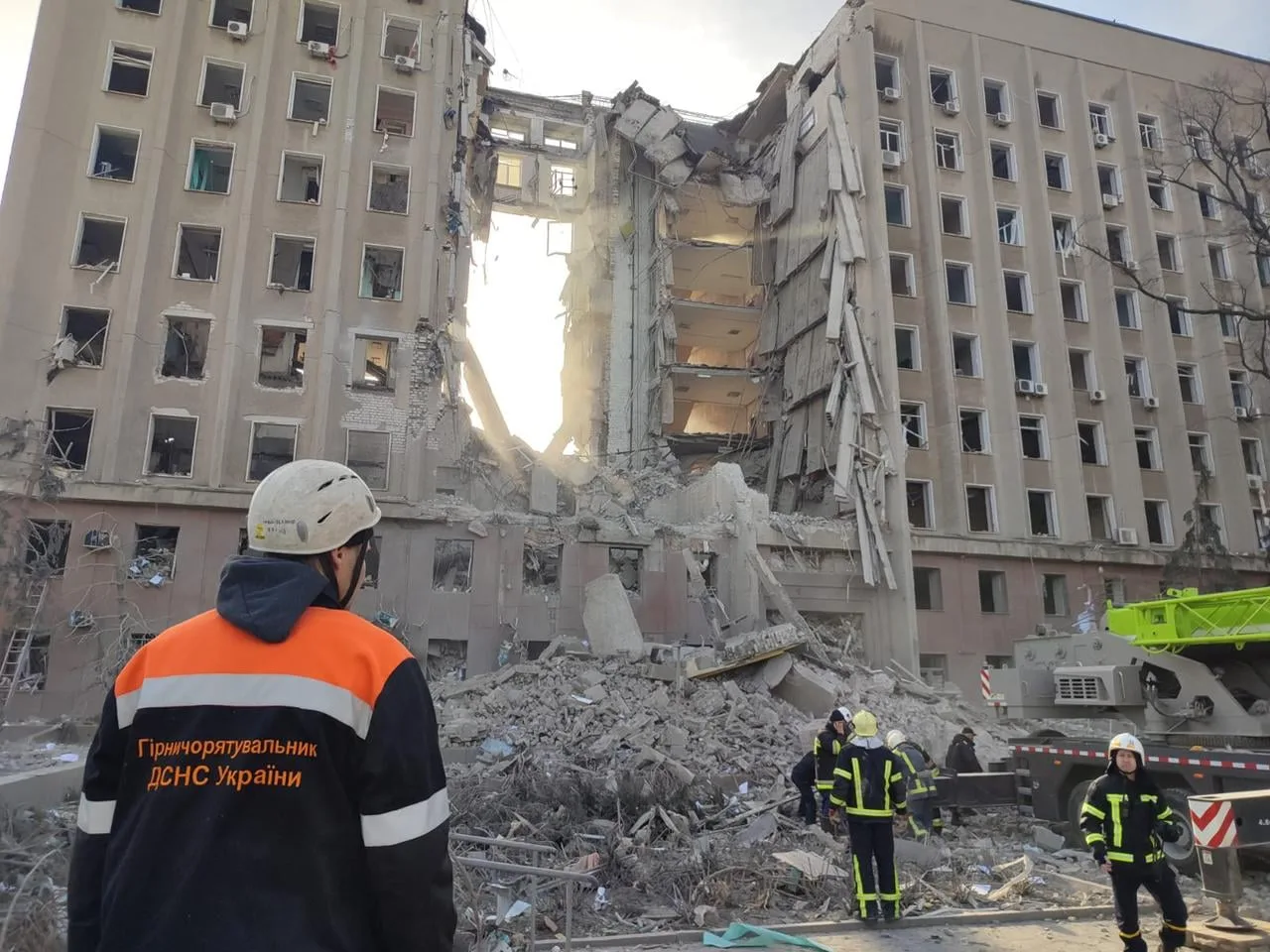
What happened on the morning of 29 March
By the end of March 2022, Mykolaiv had been under attack for several weeks, although the attacks had recently seemed to ease, as AFP wrote in The Moscow Times. By Truth Hounds’ count, between 17 March and 23 April Russian forces fired about 30 Kalibr-type cruise missiles towards the city and region, of which about 13 were shot down. On 5 March, three-year-old Arina Butym and her sister Vira Biriukova were killed in the shelling of the village of Mishkovo-Pohorilove near Mykolaiv.
The building at 22 Admiralska Street is described in the notice of suspicion published by the Prosecutor General’s Office: nine storeys, 9,690.8 square metres, in the historic zone of the city centre. Within a 400-metre radius are government bodies, residential high-rises, institutions and shops. The administration had not moved since the invasion began and occupied two floors of the building.
The working day began at eight. There was no air-raid alert in the region before the strike, Truth Hounds also note.
At 08:35 the missile hit the central part of the building at the level of the 4th and 5th floors. It exploded inside. Most of the left wing collapsed from the ninth floor to the first, along with the central section and its stairwells; the right wing was badly damaged. Investigators consider the building beyond restoration.
The moment of impact was recorded by a camera on the roof of the Admiral residential complex, 40 metres from the building. Regional head Vitalii Kim published the footage on Telegram that same day.
According to the State Emergency Service, by 09:25 rescuers had freed 17 injured people from the rubble. Kim wrote on Telegram: “Between 50 and 100 people got out. We are now looking for eight civilians and three soldiers.” He later said that the strike caught people on the stairs and by the windows: “The police pulled people out of the windows within seconds, and that saved their lives.”
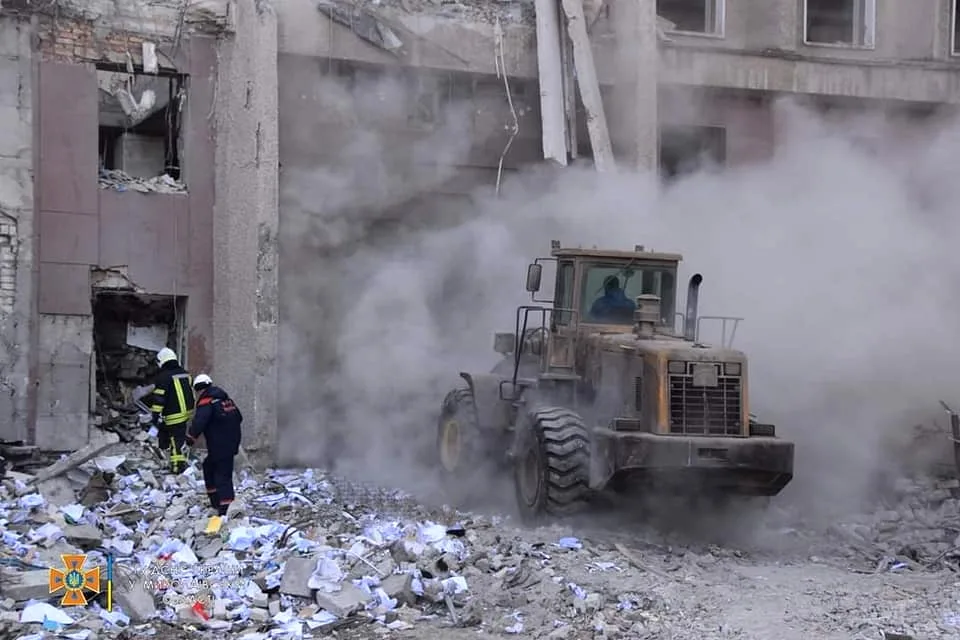
The search and rescue operation lasted five days; clearing the debris, according to Truth Hounds, took almost a month. On 2 April the body of Kim’s secretary was recovered from the rubble.
The blast also damaged ten other sites: the Palace of Student Creativity, branches of Ukrposhta and Ukrtelecom, the State Archive of the region, a pre-trial detention centre, the tax service and premises in residential buildings 29, 31 and 31-B on the same street.
According to the Ukrainian Association of Professional Photographers, as of March 2025 this was the deadliest strike on Mykolaiv residents of the entire full-scale war. On 29 March 2026, relatives and colleagues of the dead gathered at the same ruined building.
Where Kim was
The missile hit the wing where the head of the administration had his office on the fourth floor and the head of the regional council on the third, as a witness interviewed by Truth Hounds described it. “They wrecked half the building, they hit my office, the bastards,” Kim said on video.
He himself was not at work. He has given two accounts of why. On the day of the strike he said he had overslept, and AFP told the story the same way. In spring 2023 he told journalist Dmytro Komarov something else: “I was supposed to be there. I had a meeting scheduled, but I was late and moved it by half an hour. That saved me and the part of the people who were to be at the meeting, but it did not save those who were preparing it.”
Mykolaiv mayor Oleksandr Senkevych told Current Time on the day of the strike: “Judging by the result of the explosion, it was launched to hit the fourth floor of the regional administration, exactly where the head of the administration, Vitalii Kim, works.” That is the mayor’s assumption. None of the documents we opened names Kim himself as the target of the strike.
Who worked in the building
The building belonged to the regional council. Part of it was rented by the regional administration, which from 24 February 2022 operated as the Regional Military Administration. That is why sources call the same site the RSA, the RMA or “the regional council building”.
The notice of suspicion lists who else was there: the finance and economic development departments, the infrastructure, tourism and information departments, the digital development unit. Space was rented by the regional Commercial Court, the Local Roads Agency, the municipal enterprise Hosptekhobsluhovuvannia, the National Council for Television and Radio Broadcasting and a canteen. The court, according to Truth Hounds, occupied the eighth and ninth floors.
There were also military personnel in the building. They are covered in the section on whether the target was lawful.
How many people died: 36 or 37
Publications differ, and both main figures are backed by documents.
- 37. The number of names on the list the regional administration published on 5 April 2022. Truth Hounds and local reports on the 2026 anniversary give the same figure.
- 36. The figure given by the State Emergency Service on 3 April 2022: 34 bodies from the rubble and two people who died in hospital. The same number appears in the 2025 notice of suspicion and in the SBU statement of June 2026.
- 38. This figure appears in a 2023 article by Glavred with no source given. It is in neither the investigation’s documents nor the administration’s list.
Comparing the list with the notice of suspicion narrows the discrepancy to one person:
| Category | Administration’s list, 5 Apr 2022 | Notice of suspicion, 12 Feb 2025 |
|---|---|---|
| Staff of the administration and regional council | 17 | |
| Commercial Court | 2 | |
| Municipal enterprises | 2 | |
| Civilians, total | 21 | 21 |
| Territorial Defence | 10 | |
| Military unit 3039 | 4 | |
| State Special Communications Service | 2 | |
| Servicemen, total | 16 | 15 |
| Total | 37 | 36 |
We counted the categories on the list ourselves; the result matches the breakdown by Truth Hounds. Both documents have 21 civilians, and the difference comes down to one serviceman. None of the documents we opened explains why the investigation counts one fewer. The outlet Graty, citing the administration, groups the same 37 differently: 4 National Guard members, 2 State Special Communications servicemen, 11 Territorial Defence fighters, 18 department staff and 2 court employees.
The list published on 5 April 2022
The names are transliterated from UNIAN’s Ukrainian version of the list (Russian version), which reproduces the administration’s Facebook post. The list gives no ages.
Department of Economic Development and Regional Policy: Mariia Bincheva, Anzhelika Buchkovska, Oksana Havrysh, Tetiana Demennikova, Zulfiia Kapusta, Iryna Kochetova, Svitlana Popova, Olena Turbina-Khlopina.
Department of Finance: Iryna Hryhorenko, Nataliia Lavrynenko, Artem Solonara.
Other units of the administration and regional council: Olha Zablotska (infrastructure department), Valeriia Lysyk (office supporting the leadership of the administration’s staff), Andrii Lytvynov (control sector), Stanislav Khaitov (financial and administrative support, executive staff of the regional council), Mykola Khomrovyi (mobilisation work sector), Vitalii Shamraiev (digital development).
Commercial Court of Mykolaiv Oblast: Anastasiia Dolhova, Nadiia Torkhova.
Municipal enterprises: Oleksandr Boiko (director of Hosptekhobsluhovuvannia), Andrii Tianulin (Mykolaivska Oblasna Varta).
Territorial Defence: Vladyslav Liutov, Volodymyr Motelchuk, Dmytro Oliinyk, Kostiantyn Opliat, Dmytro Ostrianyn, Petro Pavliuk, Anton Salnis, Andrii Stepasiuk, Serhii Farafonov, Serhii Shamonin.
Military unit 3039: Vladyslav Arkushenko, Kyrylo Oberemenko, Volodymyr Tokariev, Maksym Fedorov.
State Special Communications Service: Dmytro Kondratenko, Andrii Cherniavskyi.
Why the news gives so many different numbers
Most of the articles that turn up about this strike were written in the first week. They carry the figure at the time of publication:
| When | Dead | Source |
|---|---|---|
| 29 March, 13:30 | 7 | State Emergency Service via Ukrinform |
| 29 March, evening | 12 | State Emergency Service via Ukrinform |
| 30 March | 15 | Ukrinform |
| 31 March, 13:00 | 20 | State Emergency Service via Espreso |
| 1 April, morning | 24 | Ukrinform |
| 1 April, 13:15 | 28 | Ukrainska Pravda |
| 1 April, 20:00 | 31 | Ukrinform |
| 2 April, 14:00 | 35 | State Emergency Service via Interfax-Ukraine |
| 2 April, evening | 36 | Kim via Interfax-Ukraine |
| 3 April | 36 | State Emergency Service via Radio Svoboda |
| 5 April | 37 names | Administration’s list via UNIAN |
The same goes for the wounded: 22 in the first hours, then 33 and 34. The investigation gives 38, the sum of three categories: 27 civilians, 6 servicemen, 5 police officers.
What hit the building: Iskander or Kalibr
| Investigation (2025–2026) | Truth Hounds and IPHR (2022) | |
|---|---|---|
| Missile | 9M727 cruise missile, Iskander system | 3M14T Kalibr cruise missile |
| From where | Ground launch 10 km north of Dzhankoi, Crimea (Konurcha) | From the sea, most likely the frigate Admiral Essen |
| Chain of command | 12th Missile Brigade, 58th Army, Southern Military District | Black Sea Fleet |
| Impact | 08:35 | 08:35 |
| Published in support | The public text of the notice of suspicion describes no evidence | Camera footage, analysis of ships from satellite imagery, witness testimony |
The difference is not only technical: the type of missile and the launch site determine who is responsible, the district or the fleet.
Some publications also carry a dispute about the time. It is not real. In the notice of suspicion, 08:14 is when the brigade’s servicemen “carried out the attack”, that is, the launch (Suspilne reads it the same way), and the time of impact is stated outright as 08:35 Kyiv time. In retellings, 08:14 sometimes became the time of impact. “About 08:45” was the State Emergency Service’s first report. The investigation and Truth Hounds give the same time.
The investigators’ version
The notice of suspicion to Dvornikov was signed on 12 February 2025 by an SBU investigator in Mykolaiv Oblast and approved by the regional prosecutor’s office. Under this version, the 12th Missile Brigade, permanently headquartered in Mozdok, was stationed in occupied Crimea in March 2022. It was armed with Iskander systems with 9M727 cruise missiles. The document gives their characteristics: range of up to 500 km, deviation of 1–5 metres, a high-explosive warhead of about 450 kg, used against command posts in reinforced concrete bunkers.
The launch, according to the notice, took place at about 08:14, 10 km north of Dzhankoi, in the Konurcha area. 21 minutes passed between launch and impact.
In June 2026, announcing the notice of suspicion to Zusko and Goraichuk, the SBU repeated this: a surface-to-surface cruise missile from an Iskander system based in occupied Crimea. The reports of that announcement do not give the missile’s designation; it appears in the notice to Dvornikov and in Suspilne’s account.
The public part of the notice to Dvornikov does not say how the type of missile was established: it describes neither forensic examinations nor debris. Nor do the reports of the SBU’s announcement, and we did not find the text of the notice to Zusko and Goraichuk. A notice of suspicion is not a verdict. It is the investigators’ version, untested in court.
The version of Truth Hounds and IPHR
A team from Truth Hounds and International Partnership for Human Rights visited the site on 21 and 23 May 2022 and interviewed five eyewitnesses, and the Center for Spatial Technologies produced 3D models of the missile and the damage. The report came out under two titles. At Truth Hounds it is A Calibrated Crime: that is the title of the web version, dated 30 August 2022, and of the PDF. IPHR’s publication is dated 31 August, and the cover of its PDF reads A Calibrated Attack.
The conclusion rests on:
- Appearance. The camera footage shows side surfaces at a right angle to the body. The authors compare the silhouette with the Kalibr, Kh-101 and Kh-555.
- Explosion inside the building. The authors use this to set aside the Kh-101, whose warhead detonates several metres from the target. The Kalibr has a penetrating warhead.
- Speed. Between two frames of the footage the missile covered 170 metres in 0.64 seconds, that is, 266 m/s. For the 3M14 the authors give 275 m/s.
- Preliminary assessment by investigators. Sources in the investigative bodies told the authors that ballistics experts had preliminarily identified the Kalibr family from the debris. The examination was still ongoing at the time.
- Ships. According to satellite imagery, the submarines and the small missile ship Grayvoron were in Sevastopol on 28–29 March. The frigates Admiral Essen and Admiral Makarov and the corvettes Ingushetia and Vyshniy Volochok were at sea.
- A witness. A resident of Yaselka who was in the village of Ivanivka in Ochakiv district heard a missile, and about three minutes later an explosion from the direction of Mykolaiv.
The authors themselves point to the weak spots of their version:
- The coordinates of the Admiral Essen (46.14435, 31.22095) come from another OSINT source and refer to 28 March; by 30 March the ship had moved. Its position at the moment of launch is not recorded.
- The witness gave the time as between six and seven in the morning. The authors believe she was mistaken, because it was still dark at that time and she remembers it being light.
- They do not explicitly rule out a launch from three other ships near Sevastopol. The only argument against it is that residents of Solonchaky and Dmytrivka do not recall anything similar.
- The conclusion is worded as “most likely”.
The ground-launched Iskander is mentioned once in the report, in a list of missile types, as experimental. The authors do not examine this version separately and do not compare speed or silhouette with the 9M727.
What follows
Both versions start from the same point: on 29 March 2022 a Russian cruise missile hit the building at 08:35. They differ on the type of missile, the launch site and the chain of command.
Truth Hounds and IPHR consider that there are reasonable grounds to classify the strike as a war crime. The investigators classify it under Art. 28(2) and Art. 438(2) of the Criminal Code of Ukraine and have issued notices of suspicion. There is no verdict on this episode.
The investigators’ version came later and rests on case materials that are not public. It departs from the preliminary assessment in favour of the Kalibr that Truth Hounds relied on. Why cannot be checked from open material: neither the notice to Dvornikov nor the reports of the SBU’s announcement describe any examination. The Truth Hounds version can be checked step by step, but its authors did not examine the main alternative. We found no public reports that Truth Hounds have revised the report: the investigation’s page still names the Kalibr, as do local outlets.
Who gave the order
The chain the investigators describe: district, army, brigade, launch crew.
Aleksandr Vladimirovich Dvornikov, born 22 August 1961 in Ussuriysk, Army General, commander of the Southern Military District at the time of the strike. According to the notice of suspicion, he issued an operational directive to the command of the 58th Army. As of February 2025, the investigation had not established the directive’s number or date.
On 9 April 2022, eleven days after the strike, he was appointed commander of the entire invasion force. The day before that appointment came the strike on Kramatorsk railway station. Graty notes that in 2015–2016 he commanded Russian forces in Syria and was called “the butcher of Syria” in the press.
Mikhail Stepanovich Zusko (Mykhailo in Ukrainian documents), born 24 May 1972, Lieutenant General. According to the Book of Executioners project, as reported by Suspilne, he was born in the village of Vetly in Volyn, is a Russian citizen, and commanded the 58th Army from August 2020 to August 2022. The same source says he gave the 12th Brigade the combat order for the strike. Zusko also appears in another case: in March 2025 the SBU served him in absentia with a notice of suspicion over the Iskander strike on the drama theatre in Chernihiv on 19 August 2023, which killed seven people, including a six-year-old child.
Nikolai Viktorovich Goraichuk (Mykola Horaichuk in Ukrainian documents), born 16 February 1979, Colonel, acting commander of the 12th Missile Brigade from October 2021 to September 2022. According to the same data, he gave his subordinates the direct orders for the launch.
The notice of suspicion to Zusko and Goraichuk, according to Suspilne, was issued on 5 June 2026. The SBU announced it on 10 June. The launch crew itself has not been named in public sources. None of the three is in custody, and all the notices were issued in absentia.
The Truth Hounds report names others: Aleksandr Smirnov, Captain 2nd Rank, commander of the Admiral Essen, and Anatoly Peretyatko, Captain-Lieutenant, commander of the missile and artillery combat unit. They are named as part of the Kalibr version. We found no reports that they have been served with a notice of suspicion over this episode.
Was the building a lawful target
This is the central question in classifying the strike. Additional Protocol I defines a military objective as an object which by its nature, location, purpose or use makes an effective contribution to military action and whose destruction, in the circumstances ruling at the time, offers a definite military advantage. In case of doubt, an object normally dedicated to civilian purposes is presumed to be civilian.
What can be said in favour of a lawful target
There really was a military presence in and near the building, and the sources do not hide it. By itself it does not make the building a military objective: under Article 52 the building must make an effective contribution to military action, and its destruction must offer a definite military advantage. So the circumstances are best taken one by one:
- Communications. The notice of suspicion reports that military engineers of the State Special Communications Service and enlisted personnel of unit A3130 were on round-the-clock duty on the second and third floors, providing special communications for the head of the Regional Military Administration. Their duties included servicing the special communications equipment. Whether this was a military command link or the head of the administration’s official line, the document does not say.
- Guards. Police officers and enlisted National Guard personnel were on the first floor around the clock. Part of the premises, the document says, were used by the servicemen “for living in and guarding the building”.
- Weapons. There were firearms and ammunition in the building. A BTR-80 stood at the checkpoint at the intersection of Admiralska and Schneierson streets, 46 metres from the building.
- Losses. Servicemen account for 15–16 of the 36–37 dead, more than 40%, and 6 of the 38 wounded. The Truth Hounds report, relaying an administration employee’s account, calls their presence insignificant. The figure cannot be ignored, but it does not show the scale of the presence: the notice of suspicion does not say how many servicemen left the building unhurt, and a share of the dead says nothing about what they were doing.
- Status. From February 2022 the administration was called a military one. On the day of the strike Kim explained it this way: “Because classically, if you are going to capture something, you need a control centre for the region, where all the communications, networks and links are brought together.” He was talking about Russia giving up on capturing the city, not about the building’s status, but the words “control centre” are his own.
- The meeting. Kim himself mentioned that he had a meeting scheduled that morning. He did not say what kind of meeting it was.
What speaks against
- Functions. According to the notice of suspicion, the administration dealt with social, humanitarian and economic matters. After the change of name, no serviceman was appointed to a leading post in its units.
- A quotation from the notice. “The said servicemen who were in the building of the Mykolaiv Regional Council did not take part in combat operations, their planning or preparation. The firearms and ammunition present in the building as of 29.03.2022 were not used for combat and were intended to secure the premises. No meetings or activities of a military nature were held or planned in the said building on 29.03.2022.”
- Witnesses. Two administration employees told Truth Hounds that there was no headquarters or military command post in the building, that no military meetings were planned for that day and that there was no such practice. Truth Hounds add that the leadership of the Primorya operational group was not there either at that moment or earlier.
- Who was inside. Most of the dead and wounded were civilians: 21 dead and 27 wounded. The strike came during working hours, 35 minutes after the working day began, on a building with a court and a canteen.
- Warning. Article 57 requires warning of attacks that may affect the civilian population, unless circumstances do not permit. We found no reports of such a warning. The notice of suspicion states that no measures to protect civilians were taken.
What the authors of the documents conclude
Truth Hounds draw two conclusions. The main one: the building was a civilian object and the strike was a deliberate attack on it. In their view the missile’s accuracy indicates a deliberate choice of target, and there were no military targets nearby. The fallback: even if the building were considered a lawful target, the attack was disproportionate, because the losses among civilians clearly exceed any indirect military advantage.
A missile’s accuracy shows where it was aimed, not what those who launched it took the object to be.
The report and the notice also differ on the facts. Truth Hounds write that no weapons or ammunition were stored in the building, that no units were quartered there and that no combatants were stationed inside or nearby, although by their own count 16 of the 37 dead were Territorial Defence fighters and servicemen. According to the notice of suspicion, servicemen were on duty there around the clock and used premises “for living in and guarding the building”, and there were firearms and ammunition in the building, though only for guarding it. The report’s conclusion about the building’s civilian status rests on the first picture, and the notice does not confirm it.
In the notice of suspicion to Dvornikov, the investigators rely on the second logic. Their wording almost repeats Art. 8(2)(b)(iv) of the Rome Statute: the attack was carried out in the knowledge that it would cause death and injury to civilians and damage to civilian objects, “which will be excessive in comparison with the concrete and directly anticipated overall military advantage”. The same document says that putting the servicemen out of action and destroying the premises “did not affect the course of hostilities”.
Proportionality is not judged by the outcome. Protocol I speaks of the harm that may be expected, and the ICC Elements of Crimes of the advantage foreseeable by the perpetrator at the time and of the information available to them then. So 21 civilian deaths do not by themselves prove disproportion, and the notice’s phrase “did not affect the course of hostilities” describes the result. Truth Hounds answer through the timing of the strike: the working day began at 8:00, which is easy to find out, so the organisers anticipated civilian deaths. What those who planned the strike knew about the building and what they expected from it is not in the public documents.
Neither the report nor the notice separately examines two questions: whether the special communications equipment, rather than the whole nine-storey building, could be considered a military objective, and whether the head of the military administration himself could be considered a lawful target. These are different tests: a building is assessed under Article 52, a person by their status and participation in hostilities. We found no version of the target from Russia, so there is nothing to compare these arguments with.
Legal classification
Truth Hounds and IPHR: Art. 8(2)(b)(ii) and (iv) of the Rome Statute, Art. 438(1) of the Criminal Code of Ukraine, Articles 48, 52 and 85 of Additional Protocol I. The authors themselves write of reasonable grounds to consider the strike a war crime.
Investigators: Art. 28(2) and Art. 438(2) of the Criminal Code of Ukraine, violation of the laws and customs of war combined with premeditated murder, by prior conspiracy of a group of persons. The notice of suspicion lists Articles 48, 51, 52, 53, 57 and 85 of Additional Protocol I, as well as provisions on the protection of cultural property: the complex of buildings on Admiralska Street was entered in the register of monuments by an order of 18 April 2022, that is, after the strike. Proceeding No. 22022150000000082 was opened on the day of the strike.
The general rules on what a war crime is and how it differs from deaths in a lawful attack are covered in What Is a War Crime.
Russia’s position
Reuters wrote on the day of the strike that Russia denies targeting civilians and did not comment on this strike.
The 30 March summary by Defence Ministry spokesman Igor Konashenkov lists 64 objects hit; in Mykolaiv Oblast it names a special operations forces headquarters near Bereznehuvate. The regional administration building is not in that summary. We found no other Defence Ministry statement about this strike. That is the result of a search, not proof that no such statement exists.
What has not been established
- 36 or 37. Who is the one serviceman who is on the administration’s list but not in the investigation’s count. We found no official explanation.
- How many people were in the building. The notice of suspicion gives 113 “civilians”. But 21 dead, 27 wounded and 32 unhurt make 80 civilians, or 106 with servicemen and police. The document does not account for seven people. Kim spoke of about 200.
- Type of missile. Which examinations led the investigation to the 9M727, and why it departed from the preliminary assessment in favour of the Kalibr that Truth Hounds reported in 2022.
- The directive. Its number, date and text. Which object it specified and for what purpose.
- The launch crew. Who exactly carried out the launch.
- The target. Whether the target was Kim, the communications system, the region’s leadership or the building as such. The mayor and the head of the administration voiced assumptions; there are no documents.
- The meeting. What meeting Kim referred to, and whether it is compatible with the notice’s statement that no activities of a military nature took place.
- Stage of the case. We found no reports of an indictment or a trial in absentia.
- Ages of the dead. The published list does not give them, and for most names we found no biographies in open sources.
- Fate of the building. As of March 2026 it was still standing in ruins. The documents we opened contain no decision on demolition or a memorial.
Timeline of the case
- 29 March 2022 — the strike. Criminal proceeding No. 22022150000000082 is opened the same day.
- 2–3 April 2022 — Kim and the State Emergency Service report 36 dead.
- 5 April 2022 — the regional administration publishes a list of 37 names.
- 21 and 23 May, 24 July 2022 — field visits by Truth Hounds and IPHR.
- 30–31 August 2022 — the Truth Hounds and IPHR report: Kalibr, Admiral Essen, characteristics of a war crime.
- 12 February 2025 — notice of suspicion to Dvornikov: 9M727, 12th Brigade, 36 dead. The next day the Prosecutor General’s Office issues a press release.
- 5 June 2026 — notice of suspicion to Zusko and Goraichuk, announced by the SBU on 10 June.
Quotations from Ukrainian and Russian are our translation.
Sources
- Prosecutor General’s Office of Ukraine — notice of suspicion to A. V. Dvornikov, 12 Feb 2025, Ukrainian text and Russian translation
- Prosecutor General’s Office of Ukraine — press release on the notice of suspicion, 13 Feb 2025
- Truth Hounds — A Calibrated Crime. Mykolaiv government building missile strike, 30 Aug 2022
- IPHR — Investigation of missile attack on Mykolaiv Regional State Administration, 31 Aug 2022
- Truth Hounds, IPHR — A Calibrated Attack, report in PDF
- Graty — the notice of suspicion to Dvornikov and the Truth Hounds version, 13 Feb 2025
- Suspilne Mykolaiv — notice of suspicion to Dvornikov, 12 Feb 2025
- Suspilne Mykolaiv — notice of suspicion to Zusko and Goraichuk, Book of Executioners data, 9 June 2026
- Radio Svoboda — SBU on the notice of suspicion to two Russian officers, June 2026
- Interfax-Ukraine — SBU statement on Zusko and Goraichuk, 10 June 2026
- ArmyInform — the strike on the Mykolaiv RMA and the notice of suspicion to Zusko, 9 June 2026
- LIGA.net — Dvornikov gave the order, 2025
- Radio Svoboda — notice of suspicion to Zusko over the Chernihiv drama theatre, 31 Mar 2025
- UNIAN — full list of the dead, 5 Apr 2022, Russian version
- UNIAN — full list of the dead, 5 Apr 2022, Ukrainian version
- Radio Svoboda — first report: State Emergency Service and Kim’s words, 29 Mar 2022
- Radio Svoboda — State Emergency Service on 36 dead, photographs of the destruction, 3 Apr 2022
- Reuters via Cyprus Mail — first report; Russia did not comment on the strike, 29 Mar 2022
- AFP via The Moscow Times — strike on the administration building, 29 Mar 2022
- Interfax — Konashenkov’s summary, 30 Mar 2022
- Current Time — interview with Mykolaiv mayor Oleksandr Senkevych, 29 Mar 2022
- LIGA.net — 12 dead, Kim’s figures and the mayor’s words, 29 Mar 2022
- Espreso Global — Kim’s words on the day of the strike, 29 Mar 2022
- AFP via Legit.ng — profile of Vitalii Kim, 19 Aug 2022
- Glavred — Kim’s account to journalist Dmytro Komarov, 29 Apr 2023
- The Insider — Kim’s words on video, March 2022
- The Insider — 36 dead, Kim’s words on the control centre, 2 Apr 2022
- RBC-Ukraine — the body of Kim’s secretary found, 2 Apr 2022
- Ukrinform — 7 dead, 29 Mar 2022
- Ukrinform — 12 dead, 29 Mar 2022
- Ukrinform — 15 dead, 30 Mar 2022
- Espreso — 20 dead, 31 Mar 2022
- Ukrinform — 24 dead, 1 Apr 2022
- Ukrainska Pravda — 28 dead, 1 Apr 2022
- Ukrinform — 31 dead, 1 Apr 2022
- Interfax-Ukraine — 35 dead, 2 Apr 2022
- Interfax-Ukraine — Kim on 36 dead, 2 Apr 2022
- Intent — Mykolaiv commemorates 37 dead, 29 Mar 2025
- Korabelov.info — fourth anniversary at the ruined building, 29 Mar 2026
- Ukrainian Association of Professional Photographers — three years after the strike, 29 Mar 2025
- Additional Protocol I, Article 51 — ICRC
- Additional Protocol I, Article 52 — ICRC
- Additional Protocol I, Article 57 — ICRC
- Rome Statute of the International Criminal Court
- Wikimedia Commons — surveillance camera footage published by Kim
- Wikimedia Commons — State Emergency Service photo, 29 Mar 2022, CC BY 4.0
- Wikimedia Commons — State Emergency Service photo, 31 Mar 2022, CC BY 4.0
- Truth Hounds — A Calibrated Crime, report in PDF
- ICC — Elements of Crimes, Art. 8(2)(b)(iv), footnotes 36 and 37

