Arina Butym was killed on 5 March 2022 in the village of Mishkovo-Pohorilove near Mykolaiv. She was three. A Russian shell exploded near the family’s house. Her older sister, Vira Biriukova, 17, was killed with her. Their mother, Svitlana Butym, was seriously wounded. Arina’s story is recorded on the Memorial remembrance platform.
Where it all began
I’d like to tell you about the report where it all began for me personally. The report after which an abstract war, with abstract missiles, became unimaginably real. There it is — at arm’s length. With all its boundless, inhuman cruelty, with all its overwhelming horror, its irreparable grief. That report turned me upside down and inside out. After it I understood with absolute clarity that my country is a criminal, a real villain, and that it’s not that I don’t want to — I simply can’t, I can’t find any strength in me to consider myself a citizen of such a country. And those who support the “special military operation” I can no longer see as anything other than real scum and criminals.
I’d like to say a heartfelt thank you to Novaya Gazeta correspondent Elena Kostyuchenko.
Her report from Mykolaiv on 12 March 2022 became for me the best vaccine against any propaganda, a vaccine of humanity in the middle of a sick society.
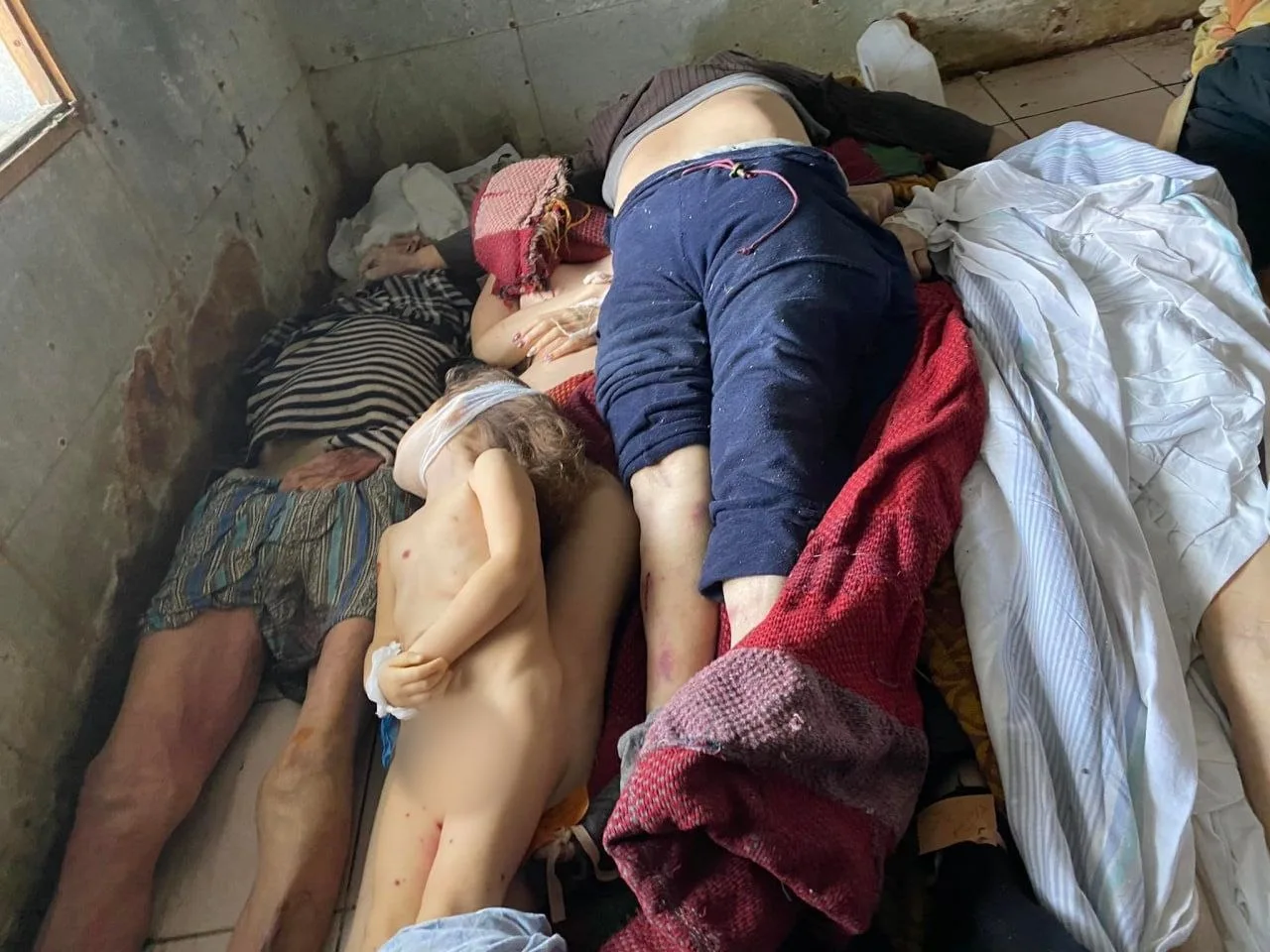
When I saw this photograph, I understood at once that this was the end. The whole fucking “Russian world” that had been growing stronger and spreading in me for years flared up like thin cigarette paper and burned to ashes. I understood that I would never accept the war in Ukraine, or Putin’s regime, or those who support it — even if that turns out to be my own mother or my childhood friends (unfortunately, that is exactly how it turned out). Every time I look at this photo, I see my daughter. She was also three back then. Arina looked very much like her. I know what children are like at that age. How they trust adults. Forgive us, Arina, for not protecting you; forgive us that in the 21st century the largest country in the world is still waging war on children and killing children. You had only just begun to live in this world, but for some reason Russia killed you, and I don’t even know why. You will never enjoy life again, you won’t grow up and have children of your own; your parents died along with you, because what comes next is no longer life — it is the torture of living. And there is nothing I can do about it.
You can come up with a million reasons to justify the attack on Ukraine, but this child will always be before my eyes, and nothing will ever outweigh her life cut short. Damn you all.
And she is just one child of the 820 killed in Ukraine as of 31 July 2026 (according to verified UN data). Just think about that number…
I wish Putin’s Russia the most catastrophic defeat; I hope that all war criminals will be brought to justice, all propagandists will receive just retribution, and all those who support this inhuman regime will be punished too. And I will do everything I can for that. It’s the least I can do for these children. Even though they no longer need it. But I need it, to remain human.
Elena Kostyuchenko’s report was removed from Novaya Gazeta’s website at the demand of Roskomnadzor and the Russian Prosecutor General’s Office. Novaya Gazeta obediently took it down, but it didn’t help — Novaya Gazeta was shut down anyway. This is so typical of authoritarian regimes, which try to gag every dissenter and everyone who tells the inconvenient, monstrous truth about them. It’s good that in today’s world this is impossible: her report lives on other sites, and with it lives the memory of the children killed by the Russian army and of the other crimes of the rashists — which means the hope that justice will be restored lives on too.
After that article I left Russia and made up my mind for good that I had to do something against the aggressor: help Ukraine’s defenders and document the crimes of the Russian army. This archive began with Arina.
We have no right to stop; whatever it takes, we must hold to account everyone involved in the killings in Ukraine. Find every war criminal and see him punished, with no statute of limitations. And we will certainly put our efforts into this. Right now — simply by helping Ukraine’s defenders (here are organisations through which you can do this), and later — by tracking down everyone involved, one by one.
Arina
Arina was born on 21 June 2018 in Mishkovo-Pohorilove. She was rarely called by her name — more often Vedmezha (“bear cub”) or Niusia. She loved drawing and building construction sets; at home she had a trampoline and a big pool.
The family loved to gather in the kitchen. Her older sister Dasha made pizza, Arina helped knead the dough, and everyone else watched a film. “It was our favourite thing to do,” her mother told Memorial.
On 4 June 2026, the Mykolaiv Regional Military Administration published a name-by-name list of the region’s children killed as a result of Russian aggression. It remembers Arina as “a little artist”.
5 March
That day the family was sheltering from the shelling in the basement. When it went quiet, the mother started on the laundry and carried water. The children were in the yard.
“I went to take the basin in, I come out, I open the door. And at that moment, the strike. The sound was such that I sank down, in pain and stunned. I didn’t understand what was happening. I want to get up, but there’s shrapnel in my thigh…” Svitlana Butym told Memorial.
Arina was lying in the yard, a small hole near her heart. Vira was in the kitchen, showing no signs of life.
Svitlana Butym was taken to hospital with serious injuries. For some time she did not know that both her daughters had been killed (Sport.ua).
In the morgue
At the morgue of the Mykolaiv regional forensic medical bureau, the orderly Mykola Chan-Chu-Mila gave Elena Kostyuchenko the sisters’ names (Mediazona):
Arina Dmytrivna Butym and Veronika Oleksandrivna Biriukova. Same mother, different fathers. Brought in on 5 March at 17:00. They lived in the village of Mishkovo-Pohorilove, Shevchenko Street. <…> We’re kin through baptism… Their parents are godparents to my children. Our families are friends. They brought the girls in on my shift. Of course I recognised them.
The girls’ father, Dmytro Butym, waited outside the fence for the bodies to be released:
Vira was heating up food in the kitchen, Arina went out into the yard. The younger one, the older one — neither had a chance. The younger one died at once, a fragment through the heart. They got the older one’s heart going for two minutes, but it wouldn’t keep beating. Their mum is in the hospital in Dubky, a fragment went through her thigh, damaged her inside. Forgive me. The main thing for me now is to bury the children.
Kostyuchenko’s caption to the morgue photograph: “Three-year-old Arina Butym lies on the body of her seventeen-year-old sister Veronika Biriukova. In the refrigerated rooms of the Mykolaiv regional forensic bureau, bodies lie in several layers. Two sheds have also been cleared to store bodies, and some of the bodies lie outside.”
Vira
Vira Biriukova was born in Mishkovo-Pohorilove. She started school early, at five and a half. She was best at maths, physics and chemistry. “Some pupils tried to copy answers; Vira — never,” recalls Olena Kachanovska, who taught her maths and physics and was her form teacher in grades 10 and 11 (Sport.ua).
Vira went to a modelling club, sewed her own dresses and outfits, learned to walk the catwalk, drew well and knitted. She played basketball from her school years and had many sports awards. She helped her mother look after Arina. After school she studied management in Mykolaiv and won a scholarship at the end of her first semester, which made her very proud. When the full-scale invasion began, she came back home to the village.
In Kostyuchenko’s report, the morgue orderly calls her Veronika Oleksandrivna Biriukova. Memorial, Sport.ua, the regional list and the girls’ father in the same report call her Vira (Vera in Russian).
Who fired
Memorial and the Mykolaiv Regional Military Administration’s list agree on one thing: the shell was Russian, and it exploded right by the house. Which weapon was used, which unit fired and from what position has not been publicly established. No reports could be found on the progress of an investigation into this episode or on anyone being named a suspect.
What has not been established
- Who fired. The unit, its commanders, the type of weapon and the firing position have not been publicly named.
- The investigation. Nothing has been published about the criminal case number, its stage or any forensic examinations.
- Vira’s full name. Vira or Veronika — the discrepancy between sources remains unresolved.
- Sport.ua’s date of death. The outlet gives 6 March 2022 as the date the sisters were killed, but in the same text describes the shelling on 5 March. Memorial gives 5 March, and according to the morgue orderly the bodies were brought in on 5 March at 17:00. The 6 March date is Sport.ua’s error.
- What happened to the family after 2022. There is no information on where Arina’s mother, father, sister and brother are now.
Sources
- Memorial — “Arina Butym, Mishkovo-Pohorilove village, 3 years old” — dates of birth and death, the mother’s account
- Mediazona — “Mykolaiv. Elena Kostyuchenko’s report that Novaya Gazeta deleted at Roskomnadzor’s demand” (29.03.2022; in Novaya Gazeta — 12.03.2022) — the words of the morgue orderly and the father, the photo caption, the publication history
- Sport.ua — “Let us bow our heads. Vira Biriukova was killed together with her three-year-old sister” (06.03.2026) — Vira’s biography, her teacher’s words, the mother’s hospitalisation
- Pivdenna Pravda — “22 lives cut short: the Regional Military Administration has published a name-by-name list of children killed in Mykolaiv Oblast as a result of Russia’s aggression” (June 2026) — the Mykolaiv Regional Military Administration’s list
- OHCHR — Human Rights Monitoring Mission in Ukraine (HRMMU), reports — 820 children killed as of 31.07.2026
- Wikipedia — “Novaya Gazeta” (in Russian) — revocation of the media licence on 05.09.2022
- Wikipedia — “Mishkovo-Pohorilove” (in Ukrainian) — the village’s location and coordinates
Quotes from Russian- and Ukrainian-language sources are given in translation.