Key facts
- Date: 27 June 2022
- Time of impact: 15:51 EEST (12:51 UTC) — strike on Amstor shopping mall; 15:59 EEST (12:59 UTC) — strike on the Kredmash road-machinery plant. Times reconstructed by the Ukrainian OSINT institute Molfar from CCTV footage, social-media metadata, and cross-referencing of camera timestamps.
- Location: Amstor shopping mall, Ihor Serdyuk Street, Kremenchuk, Poltava Oblast, Ukraine (49.0700° N, 33.4250° E)
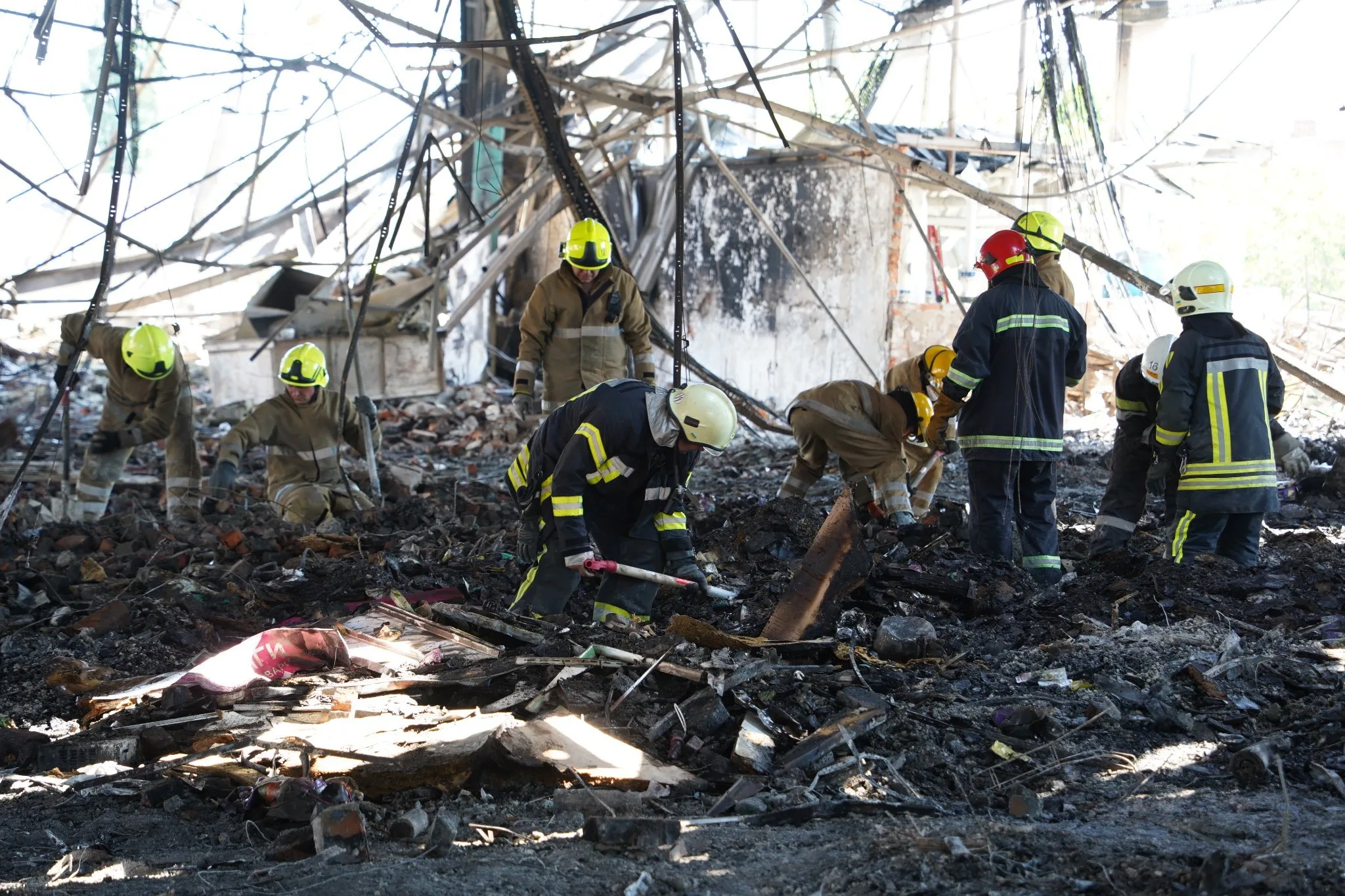
- Casualties: 22 killed, 59 wounded (final figures after debris removal completed on 2 July 2022, confirmed by Kremenchuk mayor Vitaliy Maletskyi)
- Weapon: 2 Kh-22 cruise missiles (NATO designation AS-4 Kitchen, supersonic anti-ship)
- Launch platform: Tu-22M3 strategic bombers, taking off from Shaykovka air base (Kaluga Oblast, Russia); missiles released from Russian airspace over Kursk Oblast
- Unit (per Ukrainian OSINT investigators Molfar and Ukraine’s Defence Intelligence GUR): 52nd Guards Heavy Bomber Aviation Regiment, part of the 22nd Guards Heavy Bomber Aviation Division
What is firmly established versus what remains a working assessment
Firmly established
- The Amstor shopping mall was open and full of customers and shop staff at the moment of impact — confirmed by interior video recordings from 25, 26, and 27 June, photographs of cash receipts dated 27 June, internal Telegram chats among employees, and on-site interviews with survivors.
- Both impacts were direct missile strikes, not “secondary fires.” Sequence: first the mall (15:51), then the plant (15:59) — the exact opposite of the Russian Ministry of Defence narrative.
- The mall and the plant are about 300–500 metres apart and separated by a wall, vegetation, and a railway embankment.
- The weapon used was the Kh-22 cruise missile (identified from debris recovered on site by Ukrainian specialists).
- The launch platform was a Tu-22M3 of the 22nd Guards Heavy Bomber Aviation Division, taking off from Shaykovka.
- The Kredmash plant manufactures road-construction equipment; satellite imagery shows no signs of munitions storage.
Remaining working assessments
- The intended target. The UK MoD (29 June 2022 daily intelligence update) considered it a “realistic possibility” that planners aimed at the adjacent infrastructure facility but were “willing to accept a high level of collateral civilian casualties.” This is a plausible hypothesis, not a proven fact.
- Seeker lock-on. The hypothesis that the missile’s active radar seeker locked on to the radar-contrasting roof of the mall instead of the plant is a technical explanation consistent with the Kh-22’s design, but no direct evidence proves this specific scenario.
- Number of people in the mall at the moment of impact. President Zelenskyy estimated “more than 1,000”; this figure cannot be independently verified (see “How many people were in the mall” below).
- Personal accountability of specific pilots and commanders. Established by Ukrainian investigators and OSINT researchers (Molfar) from open sources; not yet established by a court verdict.
Minute-by-minute reconstruction
Times are in EEST (UTC+3, Ukrainian summer time) and reconstructed from CCTV, satellite imagery, and the metadata of public posts. Margin of error: roughly ±1 minute.
| Time (EEST) | Event | Source |
|---|---|---|
| ~15:48 | Air-raid siren in Kremenchuk; some shoppers leave the mall | Eyewitness reports (BBC) |
| 15:51 | First missile hits the Amstor shopping mall | Molfar (from social-media video and footage shared by a Ukrainian presidential adviser) |
| 15:59 | Second missile hits the Kredmash plant (~300–500 m north of the mall) | Molfar (from CCTV in the City Park) |
| ~16:00 | Fire in the mall reaches full intensity; over 10,000 m² involved | BBC |
| ~17:02 | Pro-Kremlin Telegram channel “Voenkor Kotyonok” pushes a “staged-attack” narrative — before any official Russian MoD statement | Molfar |
| Evening 27 June | President Zelenskyy: “more than 1,000 people in the mall,” 18 confirmed killed at that moment | CNN |
| 28 June, ~11:11 MSK | Russian MoD publishes its version: strike on a “munitions warehouse,” mall “non-functioning,” fire was secondary | Statement via RIA Krym |
| 29 June | OSINT debunking: BBC, France 24, Bellingcat, and Molfar publish independent investigations | See “Evidence” section |
| 29 June | UK MoD: “realistic possibility” the target was nearby infrastructure, but civilian risks were accepted | Daily Defence Intelligence Update |
| 2 July | Debris removal complete; final figures: 22 dead, 59 wounded | Interfax-Ukraine, mayor Maletskyi |
| 14 January 2023 | Kh-22 strike on a residential building in Dnipro (46 dead). Molfar links it to the same 52nd Regiment | Globe and Mail |
| 20 October 2024 | A pilot of the 52nd Regiment, Dmitry Golenkov, found dead in Bryansk Oblast — implicated by Ukraine’s GUR in both the Kremenchuk and Dnipro strikes | Kyiv Independent |
Timeline and substance of the event
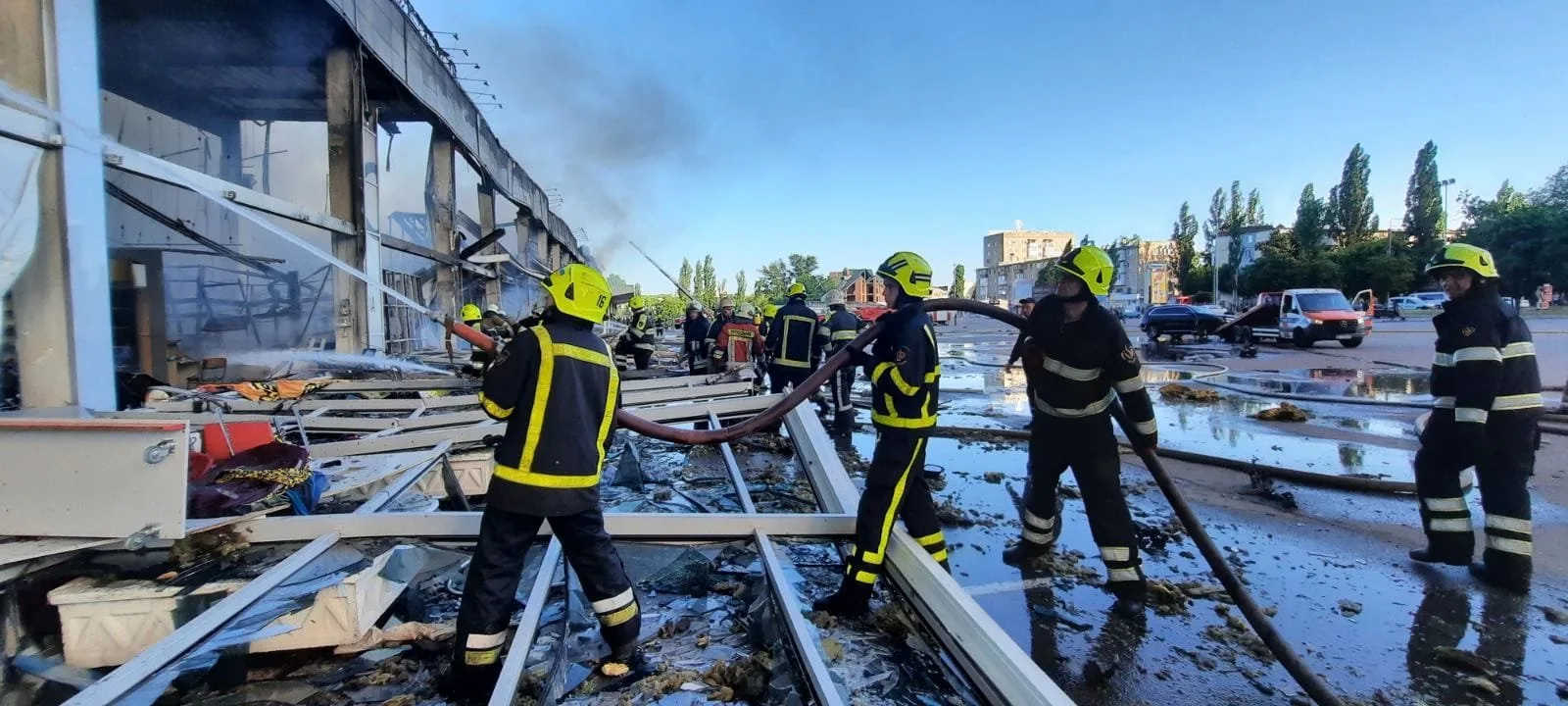
On 27 June 2022 at 15:51 local time, a Kh-22 missile struck the central section of the Amstor shopping mall — Kremenchuk’s largest retail facility, with a footprint of around 10,000 m². Eight minutes later, at 15:59, a second missile hit the territory of the Kredmash road-machinery plant some 300–500 metres to the north.
The air-raid siren had sounded a few minutes earlier. Some shoppers managed to leave the building; dozens of people — mostly retail employees and customers — remained inside. Maxim Musienko, 26, an electronics-store employee, told the BBC that around 100 customers were in his store alone at the moment of impact.
The fire engulfed more than 10,000 m². Over 115 firefighters and 20 fire vehicles were deployed. The search-and-rescue operation continued from 27 June until 2 July.
The 27 June 2022 strike was the fifth Russian attack on Kremenchuk since the start of the full-scale invasion (previous: 2 and 24 April, 12 May, 18 June) and the deadliest in the city’s history.
The weapon: the Kh-22
Technical specifications
The Kh-22 (NATO: AS-4 “Kitchen”) is a heavy supersonic air-launched cruise missile developed by the Raduga design bureau in the 1960s for the destruction of carrier strike groups.
- Length: over 11 metres
- Launch mass: ~5,800 kg
- Warhead: up to 1,000 kg (high-explosive shaped-charge)
- Speed: up to Mach 4.6 (around 1,400 m/s)
- Range: up to 600 km
- Engine: dual-mode liquid-propellant rocket engine
- Propellants: unsymmetrical dimethylhydrazine (UDMH, “heptyl”) with nitrogen tetroxide oxidizer. Both are first-class hazardous substances; in case of incomplete warhead detonation, residual fuel can cause chemical burns and severe poisoning.
- Guidance: inertial with active radar terminal seeker
Attack profile and the urban-environment problem
The Kh-22’s standard profile: high-altitude launch, climb to 22–25 km, then ballistic dive on the target at supersonic speed. The active radar seeker was designed to lock on to large radar-contrasting targets against a sea backdrop — primarily aircraft carriers.
Radar contrast of the mall as a “false target” for the seeker
In dense urban terrain, the Kh-22’s active radar seeker cannot distinguish civilian from military structures. It simply seeks the target with the largest radar cross-section in its search field.
From the seeker’s perspective, the Amstor mall was a more attractive target than the Kredmash plant itself:
- continuous flat metallic walls and a large-area roof produce a strong radar return;
- relative isolation in an open parking lot makes the return “clean,” with no clutter from neighbouring structures;
- an industrial plant with scattered shop floors, tall vegetation, and railway infrastructure produces a diffuse, weaker signature.
This does not prove that an operator deliberately aimed at the mall — but it shows that choosing the Kh-22 for a strike in a dense urban environment knowingly entails a high probability of hitting a civilian object, even when the formal target is industrial.
Accuracy: CEP about 600 metres
According to military analyst Sébastien Roblin (19FortyFive, 29 June 2022), the Circular Error Probable (CEP) of the Kh-22 against ground targets is on the order of 600 metres: “only half of the missiles fall within 600 metres of the aim point.”
The UK MoD, in its 29 June 2022 Defence Intelligence Update, stated:
There is a realistic possibility that the missile strike on the Kremenchuk mall on 27 June was directed at a nearby infrastructure target. Russian planners are likely to remain willing to accept a high level of collateral civilian casualties when they perceive a military necessity to strike the target.
Why the Kh-22 specifically
The use of an anti-ship missile against ground targets in urban areas is explained in a RUSI report (Royal United Services Institute, November 2022) by depleted stocks of more accurate modern weapons. On 13 May 2022, Ukraine’s then commander-in-chief Valery Zaluzhnyi stated that Russia had switched to the Kh-22 precisely because of its precision-weapon shortage and aviation losses.
From the start of the full-scale invasion through early 2023, more than 210 Kh-22 / Kh-32 missiles were fired at Ukraine, and not one was intercepted — Ukraine’s air defences at the time had no effective countermeasure against this missile class (Ukrinform, January 2023).
Comparative context: Kh-22 strikes on civilian sites
The strike on Amstor is not an isolated incident but part of a pattern of Kh-22 use against urban civilian objects with predictably mass casualties:
| Date | Location | Point of impact | Casualties | Source |
|---|---|---|---|---|
| 27.06.2022 | Kremenchuk, Poltava Oblast | Amstor shopping mall | 22 killed, 59 wounded | Wikipedia |
| 01.07.2022 | Serhiivka, Odesa Oblast | 9-storey apartment block, holiday resort | 21 killed (16 in the apartment block, ≥5 in the resort), 38 wounded | Wikipedia |
| 14.01.2023 | Dnipro | 9-storey apartment block on Peremohy Street | 46 killed (including 6 children), 80 wounded | Wikipedia |
In all three cases:
- the Kh-22 — a missile designed to destroy carrier strike groups against open sea — was used;
- the targets were in dense civilian urban areas;
- the result was mass civilian casualties.
This pattern is the principal counter-argument against treating any single strike as accidental.
The Russian side’s narrative
On 28 June 2022, Russian MoD spokesman Igor Konashenkov stated:
Russian Aerospace Forces conducted a high-precision air strike on hangars storing weapons and ammunition supplied by the United States and European countries near the Kremenchuk road-machinery plant. The detonation of the stored ammunition for Western weaponry caused a fire in a non-functioning shopping mall located near the plant.
In parallel, several mutually exclusive versions were pushed through Russian official and pro-Kremlin channels:
- The mall was “non-functioning” and closed to the public.
- The fire in the mall was a result of “ammunition detonation” at the neighbouring plant.
- The attack was a “Ukrainian provocation” (the version pushed by Russia’s deputy permanent representative to the UN, Dmitry Polyanskiy, as quoted by the BBC).
- The mall housed Ukraine’s Territorial Defence Forces / military equipment.
- The strike was a “staged event using mannequins / preserved bodies” (pro-Kremlin Telegram channels).
These narratives are logically incompatible: one cannot simultaneously claim that Russia struck “a legitimate military target” and that the strike was “a Ukrainian provocation.”
Evidence and investigations
Verification methodology
Below are the OSINT methods used by independent research groups (Bellingcat, France 24 Observers, Molfar) to verify the circumstances of the strike. This is not a claim that Russian Trace conducted these investigations itself — only a description of the work already published by others:
- Geolocation of video recordings — matching frames against Google Street View / Google Earth to determine camera position and direction (used by France 24 Observers on the City Park CCTV video and on the footage shared by Ukrainian presidential adviser Mykhailo Podolyak).
- Timestamp cross-referencing — analysing post metadata and video witness records to build a chronology (used by Molfar to fix the two impact times: 15:51 and 15:59).
- Before/after satellite imagery — Planet Labs imagery from 28 June 2022, analysed by Bellingcat and France 24, showed localised destruction at the mall and at the plant with no signs of fire spread between them.
- Open-source verification — analysis of cash receipts, photographs, employee chat logs, and video witnesses to disprove the “non-functioning” thesis.
- Missile-debris analysis — identification of fragments published by the Ukrainian side as belonging to the Kh-22.
- Open-source identification of the unit — Molfar’s method: searching award publications, photographs from ceremonies, and social-media profiles to compile a list of personnel linked to Shaykovka air base (Globe and Mail, January 2023).
- Cross-verification of testimonies — comparing independent eyewitness accounts from different outlets (BBC, Reuters, France 24).
1. The mall was open and full of people
The “non-functioning” thesis has been refuted by several independent sources:
- BBC reporters on the ground interviewed survivors who had been inside. Maxim Musienko, an electronics-store employee, said about 100 customers were in his store alone at the moment of impact (BBC News, 28 June 2022).
- Interior video recordings from 25, 26, and 27 June show working stores and shoppers. One YouTube clip contains a price tag dated 26 June. The videos were verified by BBC and France 24 Observers.
- Photographs of cash receipts dated 27 June, posted on social media and verified by Bellingcat and France 24.
- A screenshot of the staff Telegram chat (dated 23 June) instructing employees to work 8:00–21:00 despite air-raid sirens.
- “Missing person” appeals in the local Telegram channel in the hours after the strike, naming specific stores where the missing persons worked. The same link was used in the BBC fact-check.
- Additionally: according to a statement by Ukraine’s parliamentary committee on finance, the mall recorded around USD 100,000 in sales on the day of the strike.
2. The mall was hit directly, not as “a result of detonation”
The “secondary fire” version is refuted by video, satellite, and timing data:
- CCTV from the City Park (about 600 m north of the mall) recorded two separate impacts. The camera was geolocated by France 24 Observers using Google Street View. Order of strikes: first the mall (15:51), then the plant (15:59) — the opposite of the Russian MoD version.
- Planet Labs satellite imagery from 28 June 2022 (provided by France 24 and analysed by Bellingcat) shows localised destruction at the mall and at the plant. There are no traces of fire spread between the two sites.
- Footage of the moment of impact released by Ukrainian presidential adviser Mykhailo Podolyak captured a missile hitting the mall directly. The video was geolocated by France 24 via Google Earth.
- The 8-minute gap between the two impacts makes the “secondary fire from ammunition detonation” version physically incoherent: the fire at the mall began before the plant was even hit.
Barrier analysis: why the fire could not have spread
Between the Amstor mall and the Kredmash plant lie 300–500 metres of open ground, divided by:
- a concrete wall and fences along the plant’s perimeter;
- a tall railway embankment with active rail lines;
- a vegetated strip between the mall’s parking lot and the plant.
Given this configuration, it is physically impossible for fire or shockwave from “ammunition detonation” inside one of Kredmash’s workshops to reach the mall through this barrier zone without damaging the structures directly in the path of propagation. Planet Labs imagery from 28 June shows the intermediate zone intact: only the two impact points are burning, with no signs of intermediate fire.
3. No “ammunition warehouse”
- The Kredmash plant manufactures road-construction equipment — primarily asphalt-mixing units. Svitlana Rybalko, a Poltava Oblast SES representative, told the BBC: “This is a place for making road-building equipment. There’s also a greenhouse next door where employees grow cucumbers” (BBC, 28 June 2022).
- The plant’s only documented military connection in the past decade is the repair of three BTR-70 armoured vehicles in 2014 (per Wikipedia, citing Ukrainian sources).
- Satellite imagery from 28 June shows no signs of munitions storage — no guarded perimeters, no specialised shelters, no characteristic dispersal patterns.
Russian MoD claims vs. established data
| Russian claim | What the data show |
|---|---|
| The Amstor mall was non-functioning | Interior videos from 25–27 June; receipts from 27 June; staff chat logs; BBC eyewitness testimony; ~USD 100,000 in sales on the day of the strike |
| The strike hit a “munitions warehouse” near the plant | The plant manufactures road equipment; satellite imagery shows no signs of munitions storage; an SES official denies any warehouse existed |
| The fire in the mall was caused by ammunition detonation at the plant | Mall hit at 15:51, plant at 15:59; mall fire started first; the two sites are 300–500 m apart, separated by a wall, vegetation, and a railway |
| The strike was a “Ukrainian provocation / staged event” | Contradicts Russia’s own MoD line about a “high-precision strike”; Kh-22 debris was identified on site; the launch was tracked by intelligence |
| Only men and military personnel were in the mall | Direct video and photo evidence of women and children present; hospitalised survivors include staff from various retail categories |
Identifying the responsible parties
Information about the unit, commanders, and pilots is based on the Ukrainian OSINT organisation Molfar’s investigation (published via Globe and Mail in January 2023) and statements from Ukraine’s GUR. These findings have OSINT-grade evidentiary value but do not substitute for judicial procedure.
-
Launch: Tu-22M3 bombers took off from Shaykovka air base in Russia’s Kaluga Oblast. Missiles were released from Russian airspace over Kursk Oblast (CNN, 27 June 2022).
-
Unit: the 52nd Guards Heavy Bomber Aviation Regiment (part of the 22nd Guards Heavy Bomber Aviation Division). Molfar links the strike order to the regimental commander, Colonel Oleg Timoshin. Per the Globe and Mail, the identification was made through layered open-source analysis:
- local Kaluga Oblast press and official post-strike publications — photographs from regimental award ceremonies held after Kremenchuk;
- materials about the same regiment’s deployment in Syria (open Russian sources from the mid-2010s);
- cross-verification through relatives’ and colleagues’ social-media profiles;
- matching the identified faces against publications about Shaykovka air base.
In January 2023, after the Dnipro strike, Molfar published a list of 44 names — from commanders and pilots to ground crew and refuellers — linked to the Kremenchuk and Dnipro strikes. Among them: Tu-22M3 crew commander Colonel Andrei Samoilov.
-
Connection to other Kh-22 strikes. The same 52nd Regiment is linked by Ukrainian OSINT investigators and the GUR to the 14 January 2023 strike on a residential building in Dnipro (46 dead).
-
The pilot. On 20 October 2024, Dmitry Golenkov — chief of staff of an aviation squadron of the 52nd Regiment — was found dead in an apple orchard in Russia’s Bryansk Oblast with multiple head injuries. Ukraine’s GUR stated that he was involved in the Kremenchuk and Dnipro strikes.
How many people were in the mall: what we know and what we don’t
The figure of “more than 1,000,” widely cited in the media, is President Zelenskyy’s estimate in his evening address of 27 June. It is impossible to independently verify the exact number of people inside the mall at the moment of impact: real-time visitor-counting systems for sites of this scale do not publicly release data, and after the fire any such records are practically unrecoverable.
What is confirmed:
- Individual stores in the mall had dozens of customers each at the moment of impact — for instance, around 100 in the electronics store alone, per the BBC interview with its employee.
- The mall was a busy site at peak hour on a weekday; about 36,000 people live within a 2 km radius (BBC).
- After the air-raid siren, some shoppers left the building; victims were primarily those who stayed (retail staff and remaining customers).
Correct formulation: between several hundred and approximately one thousand people were inside the mall at the moment of impact; the precise number cannot be established.
Legal qualification
Principles of international humanitarian law
International humanitarian law (IHL) — primarily the 1949 Geneva Conventions and the 1977 Additional Protocols — requires the simultaneous observance of three core principles in any attack:
- Distinction. Parties to a conflict are required to distinguish between the civilian population and combatants, and between civilian and military objects. Attacks must be directed exclusively at military objectives (Articles 48, 51, 52 of Additional Protocol I).
- Proportionality. Attacks that may be expected to cause incidental loss of civilian life and/or damage to civilian objects that would be excessive in relation to the concrete and direct military advantage anticipated are prohibited (Article 51(5)(b) of AP I).
- Precautions in attack. Parties to a conflict must take all feasible precautions in planning and carrying out an attack to avoid or minimise harm to civilians — including the choice of weapons, timing, and method of attack (Article 57 of AP I).
Application to the Kremenchuk strike
- Distinction. The Amstor shopping mall is a civilian object; at the moment of impact it was being used for its intended civilian purpose (commerce). A direct hit on a civilian object violates the principle of distinction.
- Proportionality. Even on the hypothesis that the intended target was the neighbouring industrial site (Kredmash), the use of a weapon with a CEP of ~600 m at a distance of 300–500 m from a populated mall meant that the probability of mass civilian casualties was knowingly high and foreseeable. This is a violation of proportionality, regardless of any “miss.”
- Precautions. Using the Kh-22 — a weapon not designed for precision strikes against ground targets in urban environments, when more accurate alternatives were available to the attacker — by itself indicates a refusal of reasonable precautions.
Indiscriminate attack
The norm most directly applicable here is Article 51(4) of AP I, which defines three categories of indiscriminate attacks:
(a) those which are not directed at a specific military objective; (b) those which employ a method or means of combat which cannot be directed at a specific military objective; (c) those which employ a method or means of combat the effects of which cannot be limited as required by this Protocol.
Article 51(5)(a) of AP I explicitly qualifies as indiscriminate, in particular, an attack:
that treats as a single military objective a number of clearly separated and distinct military objectives located in a city, town, village, or other area containing a concentration of civilians or civilian objects.
Use of the Kh-22 — a weapon whose CEP (~600 m) is comparable to the very distance between the presumed military target and the populated civilian object (300–500 m) — fits the definition of “means of combat which cannot be directed at a specific military objective.” In other words: even if the operator formally aimed at the plant, the chosen weapon is physically incapable of distinguishing the plant from the adjacent mall.
In IHL terms, this means: qualification as a “war crime in the form of an indiscriminate attack” applies regardless of whether there was a specific intent to hit the mall.
Specific norms
A strike on a shopping mall with hundreds of civilians inside falls under:
- Article 51 of Additional Protocol I — prohibition of indiscriminate attacks.
- Article 52 of AP I — protection of civilian objects.
- Article 8(2)(b)(i) of the Rome Statute of the ICC — intentional attack on the civilian population.
- Article 8(2)(b)(ii) of the Rome Statute — intentional attack on civilian objects.
- Article 8(2)(b)(iv) of the Rome Statute — attack with knowledge of disproportionate civilian casualties.
International reaction
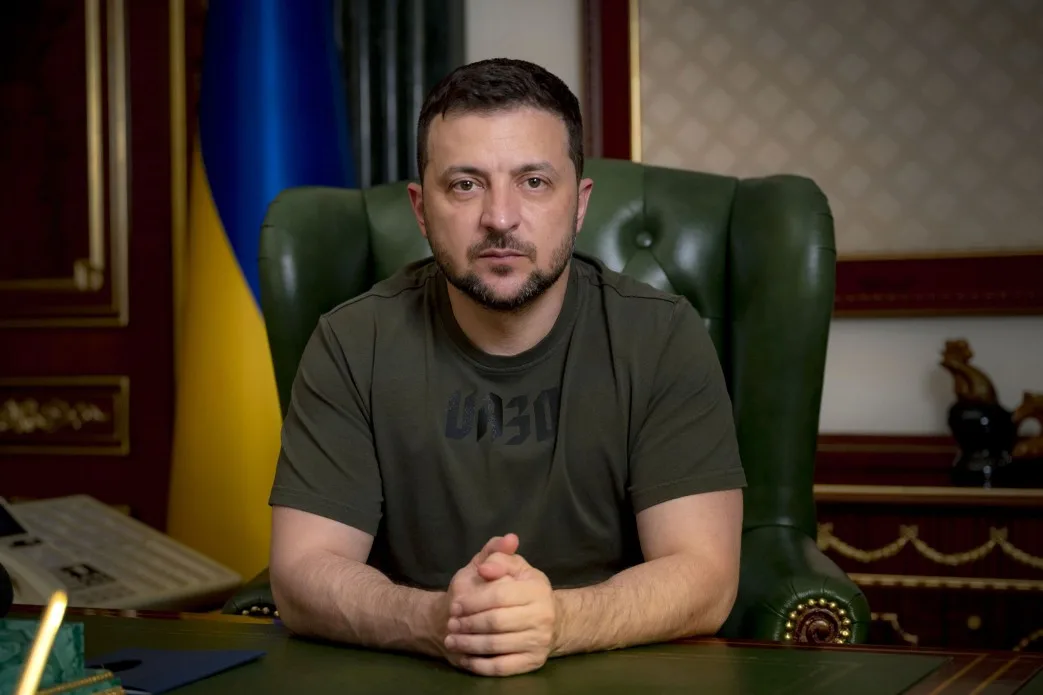
The Amstor strike happened during the G7 summit at Schloss Elmau (Germany), which produced an immediate response from world leaders.
- G7 (joint statement): “Indiscriminate attacks on innocent civilians constitute a war crime. Russian President Putin and those responsible will be held to account” (CNN, 27 June 2022).
- US President Joe Biden: described the attack as “cruel” and expressed solidarity with the Ukrainian people.
- French President Emmanuel Macron: called the strike an “abomination” and said “the Russian people must see the truth.”
- UK Prime Minister Boris Johnson: described the attack as displaying “depths of cruelty and barbarism.”
- US Secretary of State Antony Blinken: called the strike an “atrocity.”
The UN called for those responsible to be held to account; the UN Office of the High Commissioner for Human Rights (OHCHR) maintains continuous human-rights monitoring in Ukraine via the UN Human Rights Monitoring Mission in Ukraine (HRMMU).
Investigation and accountability status (2022–2026)
Ukrainian jurisdiction
The criminal investigation is being conducted by the Security Service of Ukraine (SBU) and the Office of the Prosecutor General. The Amstor strike has been qualified as a war crime under Article 438 of Ukraine’s Criminal Code (violation of the laws and customs of war). As of 2026, no public verdicts in the case have been handed down.
International Criminal Court: arrest warrant for the commander of Russia’s Long-Range Aviation
On 5 March 2024, the ICC issued arrest warrants against two senior Russian commanders:
- Lieutenant-General Sergei Ivanovich Kobylash — at the time of the warrant, Commander of Russia’s Long-Range Aviation;
- Admiral Viktor Nikolayevich Sokolov — Commander of Russia’s Black Sea Fleet.
Charges: war crime in the form of attacks on civilian objects (Article 8(2)(b)(ii) of the Rome Statute), war crime in the form of excessive incidental civilian harm (8(2)(b)(iv)), and crime against humanity in the form of other inhumane acts (7(1)(k)).
The warrants formally cover the coordinated missile-strike campaign on Ukraine’s energy infrastructure between October 2022 and March 2023. However:
- the 52nd Guards Heavy Bomber Aviation Regiment, which executed the Kremenchuk strike, is part of Russia’s Long-Range Aviation;
- Kobylash had held the post of Long-Range Aviation commander since November 2016 — including on 27 June 2022;
- the same logic of command responsibility used to charge him with the October 2022 — March 2023 strikes applies fully to the strikes on Kremenchuk (27.06.2022) and Dnipro (14.01.2023), the latter of which falls within the ICC’s reference period.
In June 2024, the ICC issued warrants against two more figures — Russian Defence Minister Sergei Shoigu and Chief of the General Staff Valery Gerasimov — on similar charges.
Russia does not recognise ICC jurisdiction and the surrender of the indicted is not anticipated in the foreseeable future. Nonetheless, the warrants restrict the indicted persons’ international movement and provide an international legal foundation for any future tribunal.
Death of an implicated person
On 20 October 2024, Dmitry Golenkov — chief of staff of an aviation squadron of the 52nd Regiment — was found dead in an apple orchard in Russia’s Bryansk Oblast with multiple head injuries. Ukraine’s GUR stated that he was involved in the Kremenchuk and Dnipro strikes; the Ukrainian side has not publicly claimed responsibility for the incident. This is the first reported death of a person whom OSINT investigations and the GUR have linked directly to the Amstor strike.
Russia’s domestic media coverage
On the day of the strike, Russian federal television channels did not report the event — until the Russian MoD released its official statement on 28 June. The picture in pro-Kremlin Telegram channels was characterised by the parallel circulation of multiple incompatible versions:
- the missile was aimed at the plant, the mall caught fire as a secondary effect;
- the mall was being used as a military equipment store;
- the mall housed Ukraine’s Territorial Defence Forces;
- the strike was a “Ukrainian provocation using preserved corpses.”
The competing versions contradicted one another. Some claimed Russia delivered “a high-precision strike on a legitimate military target.” Others claimed there was no strike at all — only a “staged event.” These positions cannot be true simultaneously.
Disinformation researchers (EUvsDisinfo, StopFake, Bellingcat) note the same pattern after other events: the Bucha killings, the strike on the Mariupol maternity hospital, and the strike on Kramatorsk railway station. The mass injection of incompatible explanations in the first hours after an event obstructs the formation of a single picture and degrades public discourse — even when none of the versions stands up to factual scrutiny.
Memory
In the days after the strike, a spontaneous memorial appeared at the ruins of the mall. Residents brought candles and flowers. Three days of mourning were declared in Kremenchuk.
Mayor Vitaliy Maletskyi, in an interview with Meduza on 1 July 2022, said the strike was carried out on a site “100% unconnected to the armed forces” and that “the time was chosen with maximum precision — peak hour.”
Memorial Square (Skver Pamʼyati)
In September 2022, with support from the Comfy retail chain (which suffered the heaviest losses among Amstor’s tenants) and a decision of the Kremenchuk City Council, a Memorial Square was created on the Dnipro embankment. The square has 22 trees planted in memory of each victim — including 10 “male” trees (maples) and 12 “female” trees (ornamental cherries and apple trees).
In 2024–2025, memorial steles bearing the names of all 22 victims were installed in the square, financed by the city budget (UAH 450,000 in the 2025–2027 development programme for additional memorial markers).
In 2024, the Memorial Square was incorporated into Ukraine’s national tourist route “Places of Memory” — an official register of sites documenting crimes against the civilian population during the Russia–Ukraine war.
The third anniversary of the strike was marked on 27 June 2025 with ceremonies at the memorial and at the former Amstor site, attended by city officials, victims’ relatives, the military, and city residents.
Names of the dead
The Comfy household-appliances store inside Amstor suffered the heaviest losses among the mall’s tenants: its premises were one of the most severely damaged parts of the building. According to the Ukrainian public memorial project Memorial.ua, the Comfy fatalities and visitors include:
- Larysa Kokhanivska, 50 — store employee; the body could not be identified, and relatives were notified of her death based on the search-and-rescue results.
- Konstantin Vozniy, 35 — store employee.
- Vyacheslav Demydov, 23, born in Kremenchuk — store employee.
- Yuriy Mykytenko, 35, born in Kremenchuk — store employee.
- Ruslan Mykolenko, 26 — store employee.
- Daniil Sidorov, 25 — store employee.
- Olena Polyakova, 31 — visitor; her husband Nikita searched for her among the missing for a long time.
These are publicly documented names, published on a specialised memorial resource (which implies the informed consent of relatives to publication). They are reproduced here as part of the documentary record, without any personal information beyond what is already public. The full list of all 22 victims, whose names are inscribed on the steles in the Memorial Square, is maintained by Kremenchuk’s city authorities.
Conclusion
Based on the available video, satellite imagery, eyewitness testimony, and the results of independent OSINT analysis (Bellingcat, France 24 Observers, Molfar), it can be stated:
- the Amstor shopping mall was open and full of people at the moment of impact;
- the strike was a direct hit by a Kh-22 cruise missile, not a “secondary fire”; the first hit was on the mall, the second on the plant, with about 8 minutes between them;
- the Russian MoD’s “ammunition detonation” version is physically impossible and contradicts verified timestamps;
- using the Kh-22 — a missile designed to destroy aircraft carriers — against an urban target with a CEP of about 600 metres in itself created a foreseeably high risk of mass civilian casualties;
- the strike fits the documented pattern of Kh-22 use against Ukrainian civilian objects (Serhiivka, Dnipro).
Taken together — regardless of whether the mall was the intended or unintended target — these circumstances meet the legal criteria for violations of the principles of distinction, proportionality, and precaution under international humanitarian law, and constitute crimes under Articles 8(2)(b)(i), 8(2)(b)(ii), and 8(2)(b)(iv) of the Rome Statute of the ICC.
Appendix A. Chronology of Russian-side statements
| Date / time | Source | Content |
|---|---|---|
| 27.06, ~17:02 | Telegram channel “Voenkor Kotyonok" | "Staged-event” version, “only men in frame,” “empty parking lot” |
| 27.06, evening | Russia’s Deputy Permanent Representative to the UN, Dmitry Polyanskiy (Twitter) | The strike is “a new Bucha-style provocation ahead of the NATO summit” |
| 27.06, 21:44 | RIA Novosti | Quoting Polyanskiy on the “provocation” thesis |
| 28.06, ~11:11 MSK | Russian MoD statement (via RIA Krym), spokesman Igor Konashenkov | Strike on “hangars storing weapons and ammunition from the US and European countries,” “non-functioning mall,” secondary fire |
| 28.06 | Russian Foreign Minister Sergei Lavrov | Endorsing the official “non-functioning mall” version |
| 28.06 | TASS | Reproducing the Russian MoD version |
Logical incompatibility of the simultaneously circulated versions
Russian sources in the first 24 hours after the strike circulated several versions in parallel, not sequentially. Their logical structure:
| Version | What it claims | Author | Conflicts with |
|---|---|---|---|
| A — “provocation” | Russia did not strike; it’s a Ukrainian staged event | Polyanskiy (Twitter, 27.06), pro-Kremlin TG | B, C, D |
| B — “strike on a munitions warehouse” | Russia delivered a high-precision strike on a military warehouse at Kredmash; the mall caught fire as a secondary effect | Russian MoD (28.06), Lavrov, TASS | A, D |
| C — “the mall was a military object” | The mall was used by Territorial Defence Forces / as a storage facility | Pro-Kremlin TG | A, B (if the mall was a military target, no “secondary fire” version is needed) |
| D — “the mall was closed, no one was inside” | The mall was closed; only military personnel in frame | Lavrov; pro-Kremlin TG | C (if the mall was a military base, people were in it) |
These versions cannot be true simultaneously: A and B are mutually exclusive on the question of who carried out the strike; C and D contradict each other on the mall’s contents. The parallel circulation of all four versions within 24–48 hours after the strike is not “refining the position” — it is evidence that none of the versions was constructed from facts, but produced reactively in response to incoming OSINT material.
Appendix B. OSINT methods and their execution by independent researchers
Russian Trace, in this article, relies on work performed by other research groups and does not claim its own geolocation or satellite-image analysis. Below are the key elements of the external OSINT work on Kremenchuk:
- Geolocation of the City Park (Misky Park) camera — performed by France 24 Observers via Google Street View. Established: the camera faces south; two distinct impact locations are visible in sequence.
- Geolocation of Podolyak’s video — performed by France 24 via Google Earth, using identifying features (the air-traffic control tower, the silhouette of the mall, a tank yard).
- Analysis of Planet Labs satellite imagery from 28 June — performed by Bellingcat and France 24. Established: destruction is localised at the mall and at the plant, with no fire traces in the intermediate zone.
- Establishing impact times (15:51 and 15:59) — performed by Molfar through cross-referencing of timestamps in videos and posts.
- Identification of the unit and personnel — performed by Molfar through open sources (awards, photos from ceremonies, social media). Published in January 2023 after the Dnipro strike.
- Identification of the debris as Kh-22 — performed by Ukrainian specialists from photographs of publicly released fragments.
- Verification of receipts, interior videos, and staff chats — performed by Bellingcat, France 24, and BBC.
We recommend that the reader consult the primary sources directly when needed (see “Sources” below).
Additional video material and reports
A curated list of verified video and audio material from international media outlets and archival platforms. All links lead to the original publications by their editorial teams; copyrights remain with their owners and links are provided as references to primary sources.
Fact-checking and independent analysis
- BBC News. Ukraine war: Kremenchuk shopping centre attack claims fact-checked — detailed video and text fact-check of Russian claims, including footage from the City Park CCTV camera (about 600 m north of the mall) that recorded both impacts.
- France 24 Observers. Disputing Russia’s claims about the attack on a mall in Kremenchuk, Ukraine — video and step-by-step camera geolocation.
- BBC World Service · Outside Source. Ukraine: Shopping centre hit by missile — radio programme with on-the-ground correspondent interviews (28 June 2022).
Ukrainian video statements
- Wikisource. Address to the nation by President Volodymyr Zelenskyy following the Kremenchuk shopping mall attack — full text of President Zelenskyy’s address on 27 June 2022 (CC BY 4.0).
- CBS News. Zelenskyy releases video claiming to show missile hitting mall — release of Mykhailo Podolyak’s video showing the moment of impact (29 June 2022).
- NBC News. Ukraine’s Zelenskyy says video shows Russians targeted Kremenchuk mall — overview of impact-moment material (28 June 2022).
Coverage by international media
- CBC News (Canada). Ukraine says Russian rocket hit shopping mall — first-day report (27 June 2022).
- RFE/RL. Zelenskiy Calls On UN To Visit Shopping Center Hit By Missile As G7 Vows Continued Support For Ukraine — text report with embedded video from the G7 summit at Schloss Elmau.
Archival media files (free licences)
- Wikimedia Commons. Category “Rocket strike on a shopping center in Kremenchuk, 27 June 2022” — 66 photo and video files from Ukraine’s State Emergency Service (SES / dsns.gov.ua) and the Office of the President of Ukraine (president.gov.ua), all under CC BY 4.0. Includes video of debris removal and wide shots of the destruction.
Sources
Primary investigations and fact-checking
- BBC News. Ukraine war: Kremenchuk shopping centre attack claims fact-checked. 28 June 2022.
- BBC News. Kremenchuk strike: ‘I didn’t think they would hit a mall — it’s a safe place’. 28 June 2022.
- Bellingcat. Russia’s Kremenchuk Claims Versus the Evidence. 29 June 2022.
- France 24 Observers. Disputing Russia’s claims about the attack on a mall in Kremenchuk, Ukraine. 30 June 2022.
- Molfar Intelligence Institute. Fact-checking of a missile strike on the city of Kremenchuk: why was it a planned terrorist attack? 29 June 2022.
- The Guardian (Lorenzo Tondo). Evidence contradicts Russian claims about Kremenchuk mall attack. 29 June 2022.
News sources
- CNN. Russian airstrike hits busy shopping mall in central Ukraine. 27 June 2022.
- Interfax-Ukraine. Number of dead, missing as result of missile attack on Amstor mall is 22 people – mayor. 2 July 2022.
- Ukrinform. Rescuers complete debris removal works at Kremenchuk mall. 2 July 2022.
- Ukrainska Pravda. «Disused» Kremenchuk shopping centre made nearly $100,000 on day of Russian attack. 29 June 2022.
- Meduza (interview with Kremenchuk mayor Vitaliy Maletskyi). «The time was chosen with maximum precision — peak hour». 1 July 2022.
Analysis and context on the Kh-22
- RUSI (Justin Bronk, Nick Reynolds, Jack Watling). The Russian Air War and Ukrainian Requirements for Air Defence. November 2022.
- Sebastien Roblin. Why Russia Is Using Old Kh-22 Aircraft Carrier-Killer Missiles to Hit Ukraine. 19FortyFive, 29 June 2022.
- Wikipedia. Kh-22 (as a meta-source with links to primary sources).
- Ukrinform. Air Force commander: Ukraine has no weapons against missile Russians fired at house in Dnipro. 15 January 2023.
Identifying the responsible parties
- The Globe and Mail (Mark MacKinnon). Behind the high-tech hunt for the Russian bombers targeting Ukrainian civilians. 21 January 2023.
- Kyiv Independent. Russian high-ranking pilot found dead in Bryansk Oblast. 21 October 2024.
Comparative context: other Kh-22 strikes
- Wikipedia. Serhiivka missile strike (1 July 2022).
- Wikipedia. 2023 Dnipro residential building airstrike (14 January 2023).
Institutional and expert sources
- Institute for the Study of War. Russian Offensive Campaign Assessment, June 27, 2022.
- Wikipedia. Kremenchuk shopping mall attack (meta-source with 41 primary references).
- UN Human Rights Monitoring Mission in Ukraine (HRMMU). Mission home page.
ICC investigation and accountability
- International Criminal Court. Situation in Ukraine: ICC judges issue arrest warrants against Sergei Ivanovich Kobylash and Viktor Nikolayevich Sokolov. 5 March 2024.
- BBC News. ICC issues arrest warrants for top Russian commanders. March 2024.
- International Criminal Court. Situation in Ukraine: ICC judges issue arrest warrants against Sergei Kuzhugetovich Shoigu and Valery Vasilyevich Gerasimov. June 2024.
Memory and memorialisation
- Memorial.UA. Comfy household-appliances store chain — obituaries.
- Kremenchutskyi Telehraf. Memorial steles bearing the names of victims of the Russian strike on Amstor have been installed in the memorial square.
- Kremenchutskyi Telehraf. The square next to Amstor in Kremenchuk to join the national “Places of Memory” route.
- Kremenchuk — moye misto. Three years after the tragedy: Kremenchuk honours the memory of the Amstor strike victims. 27 June 2025.