Key facts
- Location: Yablunska Street, Bucha, Kyiv Oblast. It runs through the industrial part of the town
- Period: March 2022, Russian occupation of Bucha
- Killed: the largest concentration of bodies in the town. At a single address — 144 Yablunska — 13 people. Investigators attribute to one reconnaissance platoon commander the deaths of 22 civilians in his area of responsibility and at least 13 attacks at the Yablunska–Vodoprovidna intersection between 5 and 9 March. The New York Times puts the figure for the whole street at between 30 and 36
- Units: the 234th Air Assault Regiment of the 76th Guards Airborne Division (military unit 74268, Pskov) and the 104th Regiment of the same division. Other episodes in Bucha also implicate the 175th Separate Reconnaissance Battalion and the 27th “Kuzbass” Special Purpose Detachment of Rosgvardia
- Command: the regiment was commanded by Artem Gorodilov. The top Russian commander at the front during the occupation of Bucha was Colonel General Alexander Chaiko, then commander of the Eastern Military District; the EU sanctioned him in March 2026
- Legal character: war crimes — intentional killings of civilians and prisoners of war, torture
What Yablunska is
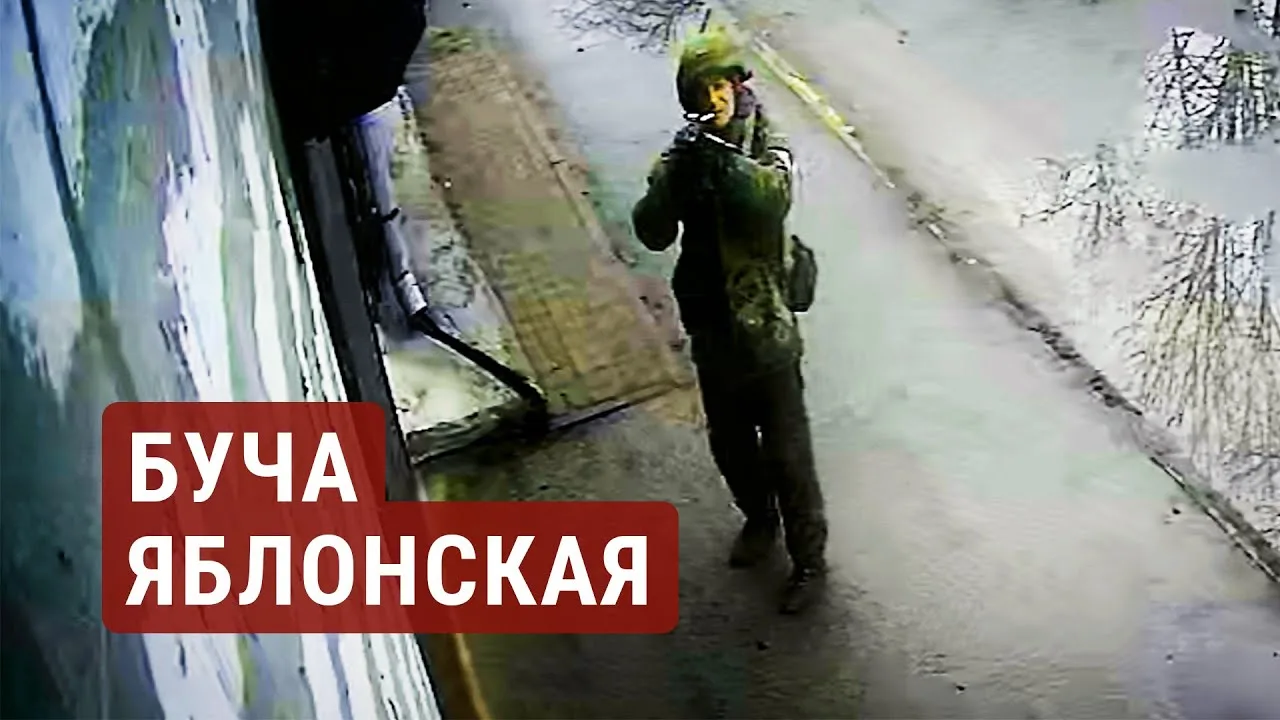
Yablunska runs through the industrial part of Bucha. The road along it was the route the Russian column took towards Kyiv.
In peacetime it is a quiet place: a lake where people fish, houses with access to fields and gardens. It also holds an old Soviet-era complex that by 2022 housed local businesses — 144 Yablunska, the Agrobudpostach depot.
Russian troops set up their headquarters here.
That explains what the street became: it was neither defended nor stormed — it was cleared. A regiment moving on the capital was securing its route.
The wider picture of the occupation is covered in a separate article — Russian War Crimes in Bucha.
4 March: 144 Yablunska
The most thoroughly documented episode. Reconstructed from the testimony of a survivor, footage from two surveillance cameras, and accounts by local residents whom Russian soldiers herded to the same building.
Thirteen people were killed at this address. Eight were detained on 4 March along with Skyba: the men from the checkpoint and the owner of the house where they had taken shelter. The other five were Bucha residents.
The unit
Ivan Skyba, 43, a taxi driver from Brovary (iStories describes him as a builder) and father of four. On the morning of 24 February he was driving in Kyiv, heard explosions, drove forty kilometres home for the family’s documents, and from there to Bucha, where his wife and children were staying with her mother.
Together with his friend Sviatoslav Turovskyi he joined the territorial defence unit then forming in Bucha. Turovskyi, born in 1987, had worked for almost four years at the Roteks printing company in Bucha; he was godfather to Skyba’s two-year-old daughter Zlata.
The unit had one rifle, one grenade and a pair of binoculars for nine men. They manned a checkpoint on Yablunska, checked documents, and carried food to people sheltering in basements.
Opposite the checkpoint, at 31 Yablunska, lived Valeriy Kotenko, 53. He brought the men hot drinks and food. As Russian troops closed in fast, he offered to shelter them.
That is where they were found.
4 March
10:00. Anatoliy Prykhidko sends his wife a message: “Still sitting tight.” It will be his last.
11:00. Two separate surveillance cameras record the detainees being led along Yablunska to number 144. Each man has one hand on the belt of the man in front and the other on his own head. Their phones and shoes had been taken earlier.
The detainees were lined up against a wall, forced to their knees, and had shirts and jumpers thrown over their heads so they could not see. They were beaten with rifle butts. According to Skyba, the soldiers shouted: “You’re Banderites! You wanted to burn us with Molotov cocktails! Now we’ll burn you alive!”
Part of what happened was witnessed by local residents — Russian soldiers ordered them to gather in front of number 144 and kept them apart from the detainees.
Afternoon. Two of the eight men captured with Skyba are shot. One of them was Vitaliy Karpenko.
Skyba recalls the soldiers talking among themselves: “What do we do with them?” — “Finish them off, just carry them out so they’re not lying here.”
“We said goodbye to one another. That was it,” he says. Among those he said goodbye to was Sviatoslav Turovskyi.
Bucha’s deputy mayor Anatoliy Shepetko described the condition of the bodies: these men “were tortured, they were abused, their eyes were gouged out, their fingers were broken, and they were shot.”
Thirteen names
Detained on 4 March:
- Sviatoslav Turovskyi, 35 (born 23 February 1987)
- Denys Rudenko, 37
- Andriy Verbovyi, 55
- Valeriy Kotenko, 53 — the owner of the house that sheltered the unit
- Anatoliy Prykhidko
- Andriy Matviychuk, 38
- Andriy Dvornikov
- Vitaliy Karpenko
Local residents killed at the same address:
- Dmytro Chaplyhin
- Viacheslav Hordiychuk
- Oleh Bilas
- Kostiantyn Zablotskyi
- Vasyl Loza
How Skyba survived
He took a bullet in the side and did not move.
The temperature was just above freezing. Russian soldiers walked between the bodies and finished off anyone showing signs of life. Skyba knew that if he exhaled, the warm breath in the cold air would give him away. He heard one of them say: “This one’s still alive!” Another answered: “He’ll die on his own.” The shot went to someone else.
When the soldiers left, he got out. He was stopped again later — he said he was the owner of the house, that his family had been evacuated, that his wounds came from shelling. They believed him and drove him to their base for treatment. Back to 144 Yablunska.
He found his family at home. They got out of Bucha, then out of Ukraine. They now live in a small village in Poland, where Skyba has work.
The bodies of the men who had held the checkpoint with him lay for the whole month of the occupation in the yard where Russian soldiers threw their rubbish. They were found on 4 April 2022.
The order to shoot everyone
The most specific thing established on this street is an order, and the man who gave it.
Artem Andriyovych Tareyev, born 1995 in Russia’s Rostov region. A lieutenant, commander of the reconnaissance platoon of the 234th Air Assault Regiment. In the battalion tactical group that entered Bucha he served as head of reconnaissance.
In March 2022 his platoon controlled the area of Yablunska, Vodoprovidna and Vokzalna streets.
Some publications call Tareyev “commander of the 234th Regiment” — that is an error introduced in retelling: the regiment was commanded by Gorodilov. Both official notices of suspicion and the Radio Svoboda investigation describe him identically: a lieutenant commanding a reconnaissance platoon.
He has been served with two notices of suspicion.
30 December 2024 — for the orders
Tareyev is accused of issuing criminal orders to shoot civilians during the occupation of Bucha between 27 February and 30 March 2022.
At least 13 attacks between 5 and 9 March at the Yablunska–Vodoprovidna intersection have been established. At least 13 confirmed dead, one of them unidentified.
Eight subordinates are named as having received his orders to shoot: Ivan Yudakov, Andrei Smirnov, Viktor Maltsev, Dmitry Syromyatnikov, Alexander Timofeyev, Artem Demenov, Daniyar Atantayev, Valery Kapustin.
1 July 2026 — for command responsibility
The second notice is built differently — not on orders, but on a commander’s failure to act.
The investigators’ wording: Tareyev, as a unit commander, failed to take proper measures to prevent crimes against civilians; through his orders and his inaction he created conditions in which his subordinates acted in the knowledge that they would go unpunished.
The charges: the intentional killing of six civilians, attempted murder of one more, and cruel treatment of at least nine. In total investigators hold him responsible under command responsibility for the deaths of 22 civilians — the number killed in his platoon’s area of responsibility.
One separate episode: during the “clearing” of a private house with his reconnaissance platoon, Tareyev took no steps to prevent the shooting of Valeriy Kizilov, 69.
The articles carry a sentence of eight to twelve years, or life imprisonment.
It was Radio Svoboda that established the reconnaissance platoon’s involvement in Kizilov’s killing — through a drone photograph and the investigative film Bucha. Yablunska. Journalism entered the criminal case as an episode.
Killed at the intersection, 5–7 March
Episodes documented by the outlet Reporters. Many are known from the photographs of Viktor Shatylo: during the occupation he photographed the street on his phone from an attic window, recording each new body as it appeared.
5 March, around 11:15. Iryna Filkina, 52. She worked as a boiler-room operator in Kyiv. In early 2022 she enrolled in a make-up course — the last class was on 23 February. From the start of the war she lived at the Epicentr store in Bucha, feeding people sheltering from the shelling and cooking for Ukrainian troops.
On 5 March she tried to evacuate but there was no room left. She decided to cycle home. She was fifteen minutes short of it.
At least 15 bullets were fired into her — from automatic weapons and from a BMD-2. Footage filmed from the air by Ukrainian troops and independently verified by The New York Times shows a cyclist riding along Vokzalna, turning onto Yablunska where Russian vehicles are standing, and the first vehicle firing several large-calibre rounds at the roadway while the second fires twice towards the person. The body was found in that same spot, next to the bicycle, after the Russian withdrawal.
Contact with Iryna was lost in the first days of the war. She was identified from a photograph of her hand — by her manicure: red polish with a heart on one nail, done for Valentine’s Day. ZAXID.NET describes a white heart on the ring finger, Reuters and RFE/RL a small purple heart bordered by silver varnish. The first to recognise her was her make-up course teacher, Anastasiia Subachova, a make-up artist from Hostomel. The photograph, taken by Reuters photographer Zohra Bensemra, travelled the world’s media and became one of the most recognisable images of the occupation of Kyiv Oblast.
Iryna left two daughters. One of them, Olha Shchyruk, founded the charitable fund Mama Ira in her mother’s memory in April 2022; it helps children who have lost parents or been harmed by the war.
5 March, photograph taken at 12:04. A blue minibus that has been fired on; opposite it, under a post, the body of a man with a green bicycle at his feet. This is 68-year-old Volodymyr Brovchenko: that day he had seen his wife and daughter off to an evacuation and set off for work along his usual road. He was shot not far from his own home. His widow recognised him from Shatylo’s photograph.
There were four people in the minibus: at the wheel the volunteer Zhanna Kamenieva, who was trying to get people out of the occupied town, and with her Mariia Ilchuk, Tamila Mishchenko and her 14-year-old daughter Ania. All of them were killed.
5 March, photograph taken at 12:46. The minibus is burning. Beside it lies the body of 61-year-old Mykhailo Kovalenko.
6 March. Shatylo’s photograph shows the body of 55-year-old Oleh Verba on the pavement, a black bag and scattered potatoes at his feet. He was unarmed: he had been carrying a bag of potatoes.
6 March. 57-year-old Mykhailo Romaniuk was cycling with a relative, Oleksandr Smahliuk, to neighbouring Irpin to dig Oleksandr’s father out of the rubble. As soon as they turned onto Yablunska, they came under fire. Romaniuk fell; Smahliuk swerved into a side lane and got away — at home he found bullet holes in his backpack. In Shatylo’s photograph Romaniuk can be seen from far off by his bright orange gloves, a bicycle beside him.
7 March. Ihor Samchenko went to check on his sister and mother-in-law, who lived near Yablunska, and did not come back. That day Shatylo counted six bodies opposite his yard; Samchenko lay next to Romaniuk. Friends found him on Yablunska but Russian soldiers would not let them approach. Four days later his wife Olha left Bucha along this street with other women and children, past his body — they were not allowed to stop.
Artem Dementyev: the sniper
On 13 September 2026 Radio Svoboda released the fourth film in its series — Bucha. The Vertical of Terror. Its central figure is a sniper.
Artem Stanislavovich Dementyev, born 20 November 1986 in Pskov. A sergeant, scout-sniper of the 234th Air Assault Regiment (military unit 74268, Pskov).
Ukrainian investigators suspect him of killing at least five civilians in Bucha and of numerous cases of torture and cruel treatment.
Documented episodes:
- 4 March 2022 — the killing of Andriy Matviychuk, 38, a territorial defence member: he was taken prisoner, tortured and shot in the back yard of the office at 144 Yablunska; according to investigators, Dementyev fired a single shot to the head. The State Bureau of Investigation release describes the same day and the same sequence — a local man born in 1984 detained, taken to a temporary headquarters on Yablunska, interrogated, tortured and shot. The release does not name him, but his age and the circumstances match the Matviychuk episode.
- 6 March 2022 — the killing of another Bucha resident on Yablunska; the name has not been released.
On 26 February 2026 the State Bureau of Investigation served Dementyev with a notice of suspicion under Part 2 of Article 438 of Ukraine’s Criminal Code — a war crime resulting in death.
The evidence, according to the State Bureau of Investigation: seized servers from external surveillance cameras, and forensic genetic, ballistic and facial-comparison examinations.
After Bucha, Dementyev was given an officer’s rank and four Orders of Courage. He was killed in combat in the summer of 2025.
Dementyev was identified by the same Radio Svoboda investigation — recognised on surveillance footage from Yablunska during the mass shootings.
How the perpetrators were identified
This is one of the cases where attribution reached individual names. Four independent lines of work.
The New York Times investigation
Eight months of work, published in December 2022. It established that the killings on Yablunska were carried out by soldiers of the 234th Air Assault Regiment.
What was used:
- surveillance camera footage — dozens of hours;
- intercepted phone calls by Russian soldiers, including calls made from the phones of the dead;
- a database of calls from Bucha to Russia — at least 16 of the regiment’s soldiers called from there;
- decoded radio traffic and a recovered document, “Radio data for radio network 8584”;
- packing slips on ammunition crates;
- equipment, uniforms and insignia left at the scene;
- social media profiles, interviews with soldiers’ relatives and with two serving soldiers who confirmed their unit’s presence.
The names of at least 22 soldiers of the regiment present in Bucha during the killings were established.
The conclusion: the killings were not an aberration but a means of securing the route to Kyiv. And: the regiment’s command could not have been unaware of the systematic killing of civilians — it was in the town.
Calls from Skyba’s phone: iStories
On 4 March, the day of the mass shooting, Russian soldiers called home from the phone they had taken from Ivan Skyba. Calls went from it to some thirty Russian numbers. The phone itself was found in early June 2022 by a resident of Yablunska Street — in her own house, where Russian soldiers had lived during the occupation — and the call list was published by the Telegram channel Bucha Live.
iStories (Vazhnye Istorii) checked every number against open data and leaked databases, then called the numbers themselves — both the relatives and the soldiers. The journalists identified eight Pskov paratroopers who most likely made calls from that phone; in some cases they received direct confirmation that it was that particular person. At least three of the eight were no longer alive by the time of publication. One of the mothers told the journalists that one could hardly believe “this horror about Russian soldiers” (iStories, 17.06.2022; video version).
The Radio Svoboda series
The journalist Dmytro Dzhulay has made four films about Bucha.
1. Bucha. The Murder of Colonel Telizhenko — May 2024.
SBU colonel Oleksiy Telizhenko served 27 years in the security service and volunteered for the front in 2016. He was killed in early March 2022; his body was not found until September 2022, in a wooded area near Bucha.
The perpetrators were traced two ways: through the colonel’s stolen medals, which turned up on display in the museum of the Rosgvardia “Kuzbass” detachment, and through the fact that Russian officers used the dead man’s phone to coordinate their movements.
This film was the first to publicly link two further units to Bucha alongside the 234th Regiment: the 27th “Kuzbass” Special Purpose Detachment of Rosgvardia and the 175th Separate Reconnaissance Battalion. On 6 August 2024, Captain Aslan Kaskulov, deputy commander of the 175th Battalion, was served with a notice of suspicion.
2. Bucha. The Murder of Self-Defence Fighter Pobihai — 6 October 2024.
At its centre is the story of Bucha self-defence fighter Oleksiy Pobihai: with no military experience, he joined the local self-defence in the first days of the invasion; soon afterwards the occupiers found him, took him from his own home and killed him. Witness testimony, intercepted Russian military phone calls, and surveillance footage the soldiers did not know existed.
In May 2025 the film won gold at the New York Festivals TV & Film Awards in the Human Rights category.
It was during this work that Dzhulay spoke personally with Sergeant Vladimir Borzunov, who confirmed that Russian soldiers had killed civilians in Bucha. The others — Artem Dementyev, Valentin Lagoda, Artem Tareyev and Yevgeny Plyusnin — did not respond to requests for comment.
3. Bucha. Yablunska. Who Killed and Tortured? — 16 June 2025, 1 hour 13 minutes.
It reconstructs three days of March 2022 on this street. In November 2025 it won the Association for International Broadcasters award for Best Investigation.
A Russian-language version of the same investigation, Bucha. Footage, Names and Officers’ Confessions, was published on the Current Time Doc YouTube channel on 12 August 2025.
4. Bucha. The Vertical of Terror — premiered on 8 September 2026 at the Heaven Space venue, published on YouTube on 13 September.
On the sniper Dementyev. Its material: witness testimony, investigative experiments, ballistic expertise, Russian military documents, and information from Ukrainian investigators.
According to the editors’ description, the film reconstructs not only the actions of one soldier but the mechanism of the Russian machine of violence and terror — from the individual perpetrator up to the command.
Across the whole series, five soldiers of the 234th Regiment have been identified:
- Yevgeny Plyusnin — captain, commander of the 5th company
- Artem Tareyev — lieutenant, commander of the reconnaissance platoon
- Vladimir Borzunov — sergeant, squad commander in the 5th company
- Artem Dementyev — sergeant, scout-sniper
- Valentin Lagoda
Plus Captain Aslan Kaskulov of the 175th Separate Reconnaissance Battalion, over the Telizhenko episode.
The Ukrainian investigation
As of 6 April 2026 the Prosecutor General’s Office reported that 215 Russian soldiers had been served with notices of suspicion for crimes in the Bucha district.
On 2 March 2026 the National Police served notices of suspicion in absentia on three more soldiers of the 234th Regiment — an assault company commander, a senior sergeant and a lance corporal. According to investigators, they took a 41-year-old Bucha resident’s car, then detained and beat him as he walked home along the railway line; on the order of the 24-year-old company commander, two of them shot him dead with assault rifles. This happened in Hostomel.
The suspicions against Tareyev and Dementyev rest directly on Radio Svoboda’s journalism: its investigation established the Kizilov episode, and its editors recognised Dementyev on the Yablunska surveillance footage.
The regiment commander
Artem Gorodilov commanded the 234th Air Assault Regiment from 2019. Born in 1984, he graduated from the Ryazan Guards Higher Airborne Command School and the Frunze Combined Arms Academy, and served in the 76th Guards Air Assault Division.
In April 2022, immediately after the withdrawal from Kyiv Oblast, an order of the defence minister granted him early promotion — for combat operations in Kyiv Oblast.
After Bucha he moved up: he was appointed to command an airborne formation in Ussuriysk — by several accounts, the 83rd Separate Air Assault Brigade.
On 4 July 2024 he was detained in Ryazan. FSB military counterintelligence brought him to Moscow and the case went to the Main Military Investigative Directorate of the Investigative Committee. A court remanded him in custody at a closed hearing.
The charge is large-scale fraud. The arrest has nothing to do with Bucha. He denies guilt.
The satellite imagery
The Russian version was that the bodies appeared on the streets after the troops left — that Ukrainians had planted them. Satellite imagery closes that off. A detailed examination of this and other narratives is in Bucha: Debunking Russian Propaganda.
The timeline from the imagery:
- 28 February 2022 — a Maxar image before the bodies appear, the baseline for comparison.
- 9–11 March — dark objects the size of human bodies appear on Yablunska. This is the conclusion of The New York Times’ analysis of Maxar imagery.
- 19 March, 11:08 local time — a Maxar image: bodies lying in the street. Their positions match what is later visible on video.
- 21 March — the bodies are in the same places. The Centre for Information Resilience report attributes this image to Planet; publications citing the NYT attribute it to Maxar. Either way it is independent confirmation two days later.
- 29 March — Russian forces left Bucha.
- 1–2 April — video by a local council member and footage by international agencies. The bodies are in the same positions as in the imagery.
Maxar spokesman Stephen Wood confirmed that high-resolution imagery over Bucha “verifies and corroborates recent social media videos and photos that reveal bodies lying in the streets.”
The New York Times’ conclusion: many of the bodies had lain in the street for at least three weeks — that is, the whole time the town was under Russian control.
Legal character
Killing prisoners of war. The detained territorial defence members were combatants and, once captured, prisoners of war. Torturing and shooting them is a grave breach of the Geneva Conventions.
Intentional attack on civilians. An order to shoot everyone who appears at an intersection is a direct instruction to fire on the civilian population as such. Not a misidentification of a target, nor excess force during an arrest.
Torture. The men killed at 144 Yablunska had their eyes gouged out and their fingers broken; in other Bucha cases the Prosecutor General’s Office records detainees tortured with a stun gun and a bladed weapon. Torture is a separate offence, independent of the killings.
Systematic character. Detention, delivery to the command post, torture, shooting, bodies left where they fell — the same pattern, repeated over a month. That is what distinguishes this from isolated excesses.
Command responsibility. A commander is liable for the crimes of subordinates if he knew or should have known and failed to act. The regiment’s command post was on the same street as the bodies.
What has not been established
This section is part of the archive’s method: it marks the limits of what is confirmed.
- The ages of most of those killed at 144 Yablunska. Only five are known: Turovskyi (35), Rudenko (37), Verbovyi (55), Kotenko (53), Matviychuk (38). Open sources give no ages for the other eight.
- The exact number killed along the whole street. Publications citing the NYT investigation range from 30 to 36. The figures 13 (the intersection), 13 (number 144) and 22 (the platoon’s area of responsibility) are different sets and must not be conflated.
- Who exactly fired in each episode. The unit’s presence is established and names are known, but the link “this man killed this man” has not been made publicly in every case.
- The status of the cases against Plyusnin, Borzunov, Lagoda and the eight subordinates named in the Tareyev file.
- Artem Demenov from the list of subordinates and Artem Dementyev — whether these are two people or one name spelled two ways.
- The name of Dementyev’s 6 March victim.
- Whether the Bucha resident born in 1984 in the State Bureau of Investigation release is Andriy Matviychuk. The age, date and circumstances match, but the release does not name him.
Sources
- Radio Svoboda — the film Bucha. Yablunska. Who Killed and Tortured? (16.06.2025)
- Radio Svoboda — Bucha. The Vertical of Terror, the film on sniper Dementyev (13.09.2026)
- Radio Svoboda — Bucha. The Murder of Self-Defence Fighter Pobihai (06.10.2024)
- Radio Svoboda — “Stolen honours”: the Russian soldiers who probably tortured an SBU colonel to death in Bucha
- Radio Svoboda — notice of suspicion to Captain Aslan Kaskulov over the killing of Colonel Telizhenko (06.08.2024)
- Radio Svoboda — identification of those involved in the Yablunska killings
- Radio Svoboda — notice of suspicion to reconnaissance platoon commander Tareyev (01.07.2026)
- Radio Svoboda — notice of suspicion to Pskov paratrooper Dementyev, from the Radio Svoboda investigation
- Radio Svoboda — the Pobihai film wins gold at New York Festivals 2025
- State Bureau of Investigation — official release on the notice of suspicion to Dementyev (26.02.2026)
- Prosecutor General’s Office — crimes in Bucha: notices of suspicion and three cases sent to court; 215 soldiers identified (06.04.2026)
- National Police — notices of suspicion to three Russian soldiers for shooting a Bucha resident on a commander’s order (02.03.2026)
- ZMINA — notice of suspicion to Tareyev for ordering the shooting of civilians (30.12.2024)
- Ukrinform — notice of suspicion to Tareyev over war crimes in Bucha
- Meduza — the NYT establishes the names of those involved in the Bucha killings: soldiers of the 234th Regiment
- Svidomi — a breakdown of the NYT investigation into the 234th Regiment
- Reporters — Yablunska. The Street of Execution: episodes of 5–7 March with names and ages
- Bucha City Council — “4 March. Bucha. 144 Yablunska”: the list of thirteen dead
- Bucha News — commemoration of the men killed at 144 Yablunska (04.03.2023)
- Bucha News — the shooting at 144 Yablunska, 4 March 2022: the names of the dead
- NV / BBC — “He survived because he played dead”: the story of Ivan Skyba, reported by Fergal Keane
- Volyn — reprint of the BBC report on Ivan Skyba
- ZAXID.NET — the story of Iryna Filkina: her work, her family, the manicure, the circumstances of her death
- 5 Kanal — police identify the killer of the “woman with the red manicure”
- Ukrainska Pravda — the NYT publishes video of Russian soldiers killing a cyclist
- Ukrainska Pravda — the killing at the corner of Vodoprovidna and Yablunska
- Ekho — portrait of the day: Artem Gorodilov, commander of the unit that operated in Bucha
- Radio Svoboda — the arrest of Colonel Gorodilov (July 2024)
- Agentstvo — the Bucha killings took place with the knowledge of the 234th Regiment’s command
- Detector Media — the presentation of Bucha. The Vertical of Terror (12.09.2026)
- Detector Media — the Radio Svoboda film on Bucha wins an AIB award (November 2025)
- Detector Media — the first part of the Bucha investigation is released (May 2024)
- Docudays UA — Bucha. Yablunska in the War Archive programme
- The Times of Israel / AFP — satellite images show bodies in Bucha for weeks; dates and Maxar comment
- Centre for Information Resilience — how Russia tried to discredit open-source evidence from Bucha
- Texty.org.ua — the NYT publishes new evidence: nine led away, eight killed
- PBS Frontline — Crime Scene: Bucha, transcript
- UGCC — His Beatitude Sviatoslav in Bucha with relatives of those killed at 144 Yablunska
- NV — the EU sanctions nine Russian soldiers involved in the Bucha atrocities; Colonel General Chaiko (16.03.2026)
- Ukrainska Pravda. Zhyttia — Iryna Filkina’s daughter founds the Mama Ira fund (09.04.2022)
- Current Time Doc — Bucha. Footage, Names and Officers’ Confessions, the Russian-language version of the Radio Svoboda film (12.08.2025)
- iStories — “Eight Pskov paratroopers in Bucha” (17.06.2022, in Russian)
- iStories — “Russian soldiers called home from Bucha on the day of the mass shooting. We found them”, video version of the investigation (in Russian)
- Reuters and RFE/RL — gallery on Iryna Filkina, including the photograph of her hand by Zohra Bensemra (Reuters), 22 Feb 2023